

|
Easy Death:
|
||||||||||||||||||||||||||||||||||||||||||||||||||||||||||||||||||||||||||||||||||||||||||||||||||||||||||||||||||||||||||||||||||||||||||||||||||||||||||||||||||||||||||||||||||||||||||||||||

The Cosmic Mandala |

Adi Da's Teaching about mortality offers real help, not mere consolation or impermanent philosophy. His Teaching addresses: preparing for the death process; near-death experiences; life after death; and reincarnation — along with practical wisdom about grief and the fear of dying. This section contains stories reflecting Adi Da's wisdom about dying, death and beyond, and how devotees and others draw upon His Instructions and His Grace to ease the death transition, and to live a life that facilitates an 'easy death'.
This section is organized as follows:
|
Adi Da recommends that everyone be told this joke on their birthday each year: A person jumps out of a skyscraper window. On the way down, someone shouts out from a window as the jumper passes by: "How's it going?" The jumper responds: "So far, so good!"
Modern Westerners are always fantasizing the future on the basis of an egoic identification with the body. The fact that every one is, inevitably, going to die, and that every thing is going to disintegrate (or pass away), is, in the modern Western view, so terrible that, characteristically, all "Westernized" individuals feel compelled to convince one another that it is not so (by constantly "selling" one another lies that "prove" it is not so). Nevertheless, the mortal "facts" really are so. Avatar Adi Da Samraj
For human beings, death Is A Proposition and A Puzzle That Must Be Understood and Transcended (By Correct and Revealing Information, or Fullest Education, and By The Real Process Of self-Transcendence). There Is No Peace For human beings Until This Matter Is Resolved. Avatar Adi Da Samraj, Eleutherios
Are you ready for death right now? Could you handle it? Can you handle the death of the other? No one could be said to be in a position to enjoy that, but there is a Profundity that Absolutely Transcends it, Absolutely Perfectly, and is Untouched, Untouched by anything at all — regardless of what happens to the body-mind, regardless of its fate and the fate of its relations. Avatar Adi Da Samraj
Part of the apparently conventional nature of our relationships is the threat of separation and death. This body dies. That body dies. We can rejuvenate, feel better, live longer, but, even so, in this world everybody dies. That is why we do spiritual practice, because we are conscious of the destiny of our separation. We are willing to fulfill the law of love, but on the other hand what we love dies. That is why this is one of the realms of suffering. This world is not a heaven. This is not a place of fulfillment. Thus, we must yield to the true Condition. We must not become dependent upon the conventional aspect of our relations. We must recognize our relations. We must identify with the Condition of the loved one.You must become established in the real Condition, or you will never be satisfied. You will be driven to all kinds of preoccupations and great schemes, trying to become victorious or immortal, for immortality’s own sake, simply because you cannot deal with the fact of death. But death is an absolute message in this realm. It obligates us to recognize or identify one another in Truth, and we are not relieved of that obligation in this place. Avatar Adi Da Samraj
Death makes your entire life bullshit. Don’t you see? That's the problem. The body is going to die, every relation of the body is going to die. You can't even depend on it continuing for another moment while you're . . . associating with it. That's the situation you’re in, but you use fabrications of mind and so forth, individually and collectively, that distract you from the fact of it, so that you won't feel it profoundly. And so you build up this whole lifetime of endeavors, of attachments, of things you own, things you do, things you’re known for, things you know, things you know about — on and on and on. And it all passes. But in the meantime. . . you bullshit one another, effectively. The Great Matter doesn’t confront you merely in death. It's just that in death you are disarmed and you have no choice. While you are alive, you delude yourself! You fabricate a reality that's not altogether true, in order to give yourself a sense of permanence, continuation, certainty — as if life is about being enthusiastic, about fulfillment of the next desire. In fact, you could easily drop dead in any moment. All kinds of people drop dead every day. And a lot of them haven't lived a very long life beforehand. All kinds of terrible things are being done by human beings to one another and otherwise by the situation itself. So you can participate in the round of desires and consolations as much as you are able for a lifetime, however long that lasts, and then be necessarily confronted by profundity at the point of death. Or you can go beyond even right now and exist in that profundity right now. . . True religious life is a great profundity. But the religious life that people propose for themselves and propose to one another, generally speaking, is the life of consolation, of distraction, of arbitrary beliefs that suggest some kind of continuation (or even permanence) of the present pattern. Avatar Adi Da Samraj
Life is terrible, and human beings are deluded by the immediate pleasures that they can receive. For these reasons, they ignore the reality of mortality — and they must not do that. The practice, while alive and at death and beyond, is surrender to the Divine — really so — and to know the Divine. Not “know” It in the thinking sense. The knowledge of which I am speaking is a gnosis beyond self-contraction. It is terrible and unbearable that people should fear death. Death is a lie, but you must Realize that that is so. And that lie must not be tolerated. Any devotee who has a devotional response to Me must enjoy being opened to the Divine Reality and experience it without doubt. You must receive My Gift and so be equipped for life and death. All is a process in this same “Bright” Energy, and you must get connected with Where you come from or you get lost in this hell of egoic life here. When the moment of death arrives, you must not be afraid to be turned up to God. You must not be holding on in your death. You must surrender to the Divine Light. That is your business here. Let it be so. Avatar Adi Da Samraj
Death is not just something that is going to happen eventually and you agree that there is nothing you can do about it so you can relax a little. You must participate in death. Death is the meaning of conditional existence, the very act of it, the principal ceremony- not just at the end of physical life, but all the time you live. Therefore, conditional existence is a great sacrificial process, and you must become a participant in it. Accept this obligation of "self"-sacrifice, and allow your confinement to that process (through "self"-discipline, through true devotional Yoga, through obliging your ego-possession to melt) — such that you become a participant in the Great Sacrifice, and you (thereby) become sensitized to the Divine Being, Truth, and Reality in Which all-and-All is arising and out-grow the realm of cosmic appearance. Avatar Adi Da Samraj, My Bright Form
'Tis a fearful thing to love what death can touch. Yehuda Halevi (1075 – 1141)
Love is a great knowledge in human intimacies, but it is a terrible knowledge, simultaneously. Love moves you beyond the usual insult of mortality, but it takes place in the context of mortality. At the same time that love relieves you, in some respects, of the insult of mortality, it also makes the suffering of mortality more profound. So, to love anyone is a terrible "problem" — friend, intimate, child, mother, father. To love at all is to be confronted with the terrible nature of mortality. Avatar Adi Da Samraj
In and of itself this is a horror, a terrible place of endings. You cannot think your way out of here — when you are lying there trying to catch the breath and feeling it going. There is no thought that you have in mind that will give you peace. None. Only the sheer and Absolute Divine Presence solves the heart. Avatar Adi Da Samraj, March 23, 2003
So do not be stupid and cruel people. Be a little more humorous and loving, and acknowledge your friends compassionately. All of them are fleshily presented, and dying. All of your women friends, all of your men friends—everyone who lives is dying and is confronted with the most incredible circumstance. All are deserving of your love and compassion, and also of your demand for the discipline of love beyond egoic "self-possession", so that they too can enjoy the intuition of this Happiness. Everyone is dying. All of these shapes get snuffed out with trembling stupidity and insanity. When the body dies, the brain becomes active for a moment, it begins to show you lighted shapes and to dissolve you beyond the elements. First you get fleshy, and then you get watery, then you get fiery, then you get airy, then you start screaming and nobody can hear you, and the body shakes all over the place, and then you are dead. I certainly wish you could acknowledge it while you are alive. If you can, you will love somebody, and if you cannot, you will not. Do not pretend that you live in a Disney world of beauty. This life is many-sided, and you do not know what it is. And your Happiness depends on the total inspection of this life. Understand the situation you are in and become manly (male or female) on the basis of this observation, so that you may be lovers and friends. Acknowledge this terrible circumstance and be Happy, and stop placing stupid obligations on one another. You exist in a place that is open-ended, an edge to the Eternal, and you are dying. The only way you can comprehend this complication is by sacrificing it and becoming a lover and a friend. Nothing else you may project in your lifetime can change that. You are still a fleshy, homely being that can be crushed by circumstance. Avatar Adi Da Samraj |
 Adi
Da has brought into the world an immense body of wisdom about mortality,
death, serving the death transition, and the Divine Reality in which
both life and death are occurring. Much of this wisdom is codified
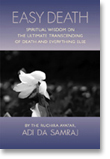
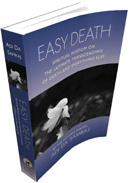
in His book, Easy
Death, which Elizabeth Kübler-Ross (author of the pioneering
work, On
Death and Dying) described as "an exciting, stimulating,
and thought-provoking book that adds immensely to the ever-increasing
literature on the phenomena of life and death." The stories
in this section are just a small sample of how Adi Da's Wisdom and
Blessing has served many people in their understanding and experience
of mortality, dying, and death, and their Awakening to the Divine
Reality altogether.
Adi
Da has brought into the world an immense body of wisdom about mortality,
death, serving the death transition, and the Divine Reality in which
both life and death are occurring. Much of this wisdom is codified
in His book, Easy
Death, which Elizabeth Kübler-Ross (author of the pioneering
work, On
Death and Dying) described as "an exciting, stimulating,
and thought-provoking book that adds immensely to the ever-increasing
literature on the phenomena of life and death." The stories
in this section are just a small sample of how Adi Da's Wisdom and
Blessing has served many people in their understanding and experience
of mortality, dying, and death, and their Awakening to the Divine
Reality altogether.
|
The dead are rotted. And they are not art. They are all the dead, the objects of your ritual. And they are not preserved. Am I right? And you are the dead — about to be. You are all waiting for it. You are all going to die. And it will not release anything. You will be eaten. You are all biding your time with this ritual of museumistic philosophy — thinking and painting and drawing and musicking and lyricking. Poetry and politics — an involvement in action and repetition and experience. Until, one day, completely out of the blue, whenever it will occur — at twenty, or thirty, forty, fifty, sixty, seventy, eighty, ninety, a hundred, a hundred and fifty years, whenever it occurs — out of the blue, you will get this stuffy sensation in your chest, and your mind will become unavailable to you, and your personality will become magnificently obsolete, and you will puke yourself out and become nothing. And, for a moment, you will fulfill the Law with your bodies. But, in the next moment, all of you will be stretched out, with a little cord of Light. It is the only thing that keeps this body alive — with three parts, into the three stations of the bodily apparent heart. And you will stand up in the room, and see your dead body, and feel so relieved from it. And that will seem like the fulfillment of the whole gesture of your understanding. But, then, you will turn around, and somebody like your mother, your uncle, the Virgin Mary, Jesus of Galilee, Gautama Sakyamuni, Swami Muktananda — somebody will be standing there saying, "Ah, hey, it's alright! You have died now, but you are not your body. Now, come with me, and we'll go into the other world." And you will believe it. And, actually, you should have been swept out centuries before, lives before, moments before your death. How unfortunate to have had to die in order to be relieved from your body. But, actually, you have not been relieved from your body-identification, only from the body itself. And, in the next moment, having submitted to this argument, this preacher of your own mind, you will be swifted into some place with all kinds of smiling, white-shirted people, whose entire business it is to make you feel as comfortable — as consoled and dead — as you could possibly be. And, then, you will be put to sleep, and you will dream for endless years. Avatar Adi Da Samraj, July 12, 1976
Ideally, it seems, it would be best if men and women did not ever have to take the life of anything, but this cannot be done. Even your next breath will slaughter beings. And you, yourself, bodily, will be given up eventually. The entire cosmic display is a kind of slaughterhouse, if you will, killing everything birthed. Observing this, one can be possessed by a desperate and negative vision. That is why one must Hear the Truth and Wake up. One must understand that, indeed, the conditional universe must be transcended, but, as a process, its greater meaning is positive. It is a process of sacrifice, of yielding, of going beyond, as best one can. Avatar Adi Da Samraj, 1987
Avatar Adi Da Samraj, June, 1980
Your consciousness must become one with this Divine Reality. You must magnify your association with That, enter into heart-Communion with That, rather than reinforce the persona, or the egoic tendencies of attention. In this way, you prepare yourself . . . for death, but you also live well. You live in Wisdom. And if you have lived a lifetime in this Wisdom, then death will certainly become a profound event, not different in kind from profound meditation. Avatar Adi Da Samraj
If you are constantly trying to survive, you become more and more afraid. You become afraid of dying, afraid of separations, afraid of the loss of things and the loss of others. The better things get, the more afraid you get. The longer you persist in the attempt to survive, the more threatened your survival becomes. Ultimately, you do change, and separations and changes do occur. Other people die, and you die. All of that is the Law, and all of that is Real God. All of that is true to everyone. But if you spend your lives in the refusal of it, in trying to survive only, death and change only 'happen' to you. Whereas, if you live in the acknowledgement of your True Condition, death does not 'happen' to you. Death becomes a process for which you are responsible, just as much as for breath and dinner. You must become a 'self'-sacrifice while alive. Only then do you live in Real God. Only the life of 'self'-sacrifice acknowledges the totality of your True Condition. You fulfill the Law through love, through free feeling-attention, through sacrifice of 'subjectivity', and, most ultimately, through sacrifice of the whole body. When you begin to become that 'self'-sacrifice, fear dissolves. Fear is only your mood, your reading of what you see reflected in your contraction, your recoil from Infinity, your attempts to survive, your own 'Narcissism'. If, instead of holding on to mind and emotion and body and relations and the 'world' itself, you release it all, there is no fear whatsoever. Fear is only the reflection of the holding on. Stop holding on, and there is obviously no fear. Then you will stop refusing the excluded aspect of the body, and the 'world', and the Divine Reality, and Real God. The failure to love is the same as the fear of death. That is why you have so much difficulty maintaining this life of love. You are afraid of death, that is the only reason why you cannot do it. The mechanism that would be love is not available to you consistently. It is locked into fear, into the attempt to survive, to define yourself through anxiety. If you give yourself up, the whole body is transformed and the whole character of your life changes. But you can only love if you are no longer afraid to die, because love is death. Love is the sacrifice of inwardness and independent existence into mere whole bodily existence, and the surrender of mere whole bodily existence into Infinity, beyond visions, beyond 'self'-definition. Love is the ecstasy of the presentation of one's existence to Infinity. That is the Way. Avatar Adi Da Samraj
People tend to think that, at death, maybe you are just dead, or else you go to heaven. For most people, death is in the future. It is not connected with the present. However, what occurs after death is actually determined by how you live and by your state of consciousness while alive. During life, the individual consciousness is limited by the physical vehicle, defined by the brain, the nervous system, the mechanism of the body. You are kept from access to most of mind by this barrier of brain and nervous system. Therefore, most of mind is in the so-called "unconscious". Because this is so, it is possible to just live your life on the basis of the stimulation of this bodily entity, and to take from life the pleasure that you can. Such is the choice that many make, because they do not understand what is on the other side of the barrier that is the body. Yet, the barrier is lifted at death, when you fall into the domain of the so-called "unconscious". Before death, you make mind. Mind is your circumstance after death, and not just the thinking mind of your limited conscious awareness. The unconscious is your circumstance after death. You know the potential in your life for dreams. If you stay healthy and keep your mind focused on positive thoughts, perhaps you will not have bad dreams. However, the nightmare is still potential all the time and after death you no longer have the physical means to prevent the unconscious from becoming conscious. If you use the circumstance of the present body-mind as a means to purify the unconscious, or the mind that is outside the realm of the brain and that is presently cut off by the brain, then the mechanisms of the unconscious will not control your destiny after death. On the other hand, if you use your lifetime simply as an opportunity to indulge in bodily-based existence, you do nothing but add to the sum total of karma in the unconscious, which then becomes your destiny. Avatar Adi Da Samraj, Easy Death |
 Life, rightly lived, is an intentional freefall. You cannot
at all prevent your death. You cannot call the hour, the day,
the moment of it — it could happen at any time. Even
right now, while we are talking. Anybody could drop dead at
any time. You cannot prevent it. You can build your life on
trying to prevent it, but it is an illusory effort, a terrible
philosophical ordeal, because you cannot prevent it. You can
indulge in illusions that desensitize you to this, and that
is what most of "religion" is about. That is what exoteric
"religion" is, for most people. It is a way of desensitizing
them to the facts of existence in this conditional life. One
cannot blame them for the fear — and their clinging,
then, to consolations. But there is no Truth in it. The true
renunciate knows there is no Truth in it, and relinquishes
those consolations, and allows the freefall. Then you make
great discoveries. That is what the esoteric life is about
— the discoveries in freefall. You cannot control the
ultimate thing you fear. That freedom from fear is about allowing
the freefall and relinquishing consolation. Your right relationship
to Me is not a matter of consolation, it is a matter of the
embrace of the Beloved, the certainty of the Absolute, under
circumstances in which you are utterly bereft of certainty
otherwise, in which you allow the overwhelming force of conditionality
to be the way it is. It is only in that disposition that you
discover the Truth of Existence.
Life, rightly lived, is an intentional freefall. You cannot
at all prevent your death. You cannot call the hour, the day,
the moment of it — it could happen at any time. Even
right now, while we are talking. Anybody could drop dead at
any time. You cannot prevent it. You can build your life on
trying to prevent it, but it is an illusory effort, a terrible
philosophical ordeal, because you cannot prevent it. You can
indulge in illusions that desensitize you to this, and that
is what most of "religion" is about. That is what exoteric
"religion" is, for most people. It is a way of desensitizing
them to the facts of existence in this conditional life. One
cannot blame them for the fear — and their clinging,
then, to consolations. But there is no Truth in it. The true
renunciate knows there is no Truth in it, and relinquishes
those consolations, and allows the freefall. Then you make
great discoveries. That is what the esoteric life is about
— the discoveries in freefall. You cannot control the
ultimate thing you fear. That freedom from fear is about allowing
the freefall and relinquishing consolation. Your right relationship
to Me is not a matter of consolation, it is a matter of the
embrace of the Beloved, the certainty of the Absolute, under
circumstances in which you are utterly bereft of certainty
otherwise, in which you allow the overwhelming force of conditionality
to be the way it is. It is only in that disposition that you
discover the Truth of Existence.
 Quite
a few books (for example, Raymond Moody's Life
After Life, or Kenneth Ring's Heading
Toward Omega) are now available that report near-death experiences,
and describe such recurring patterns as: leaving the body (and possibly
looking back at it from the outside, for a period); one's life flashing
before one's eyes (or some other kind of life summary or review);
passage through a "tunnel"; a being of light at the end of the tunnel;
and returning to life. There is a tendency in many of these books
to depict such experiences as entirely positive (and to make the
hopeful suggestion that death itself will be the same). But Adi
Da makes clear that all the aspects of one's psyche — positive
and negative — that are present (perhaps unconsciously) while alive,
come into play (in an intensified, psychic form, liberated from
physical constraint) in the transition between lifetimes. One need
only look at one's dreams at night to get some feeling for what
one will experience in the death transition.
Quite
a few books (for example, Raymond Moody's Life
After Life, or Kenneth Ring's Heading
Toward Omega) are now available that report near-death experiences,
and describe such recurring patterns as: leaving the body (and possibly
looking back at it from the outside, for a period); one's life flashing
before one's eyes (or some other kind of life summary or review);
passage through a "tunnel"; a being of light at the end of the tunnel;
and returning to life. There is a tendency in many of these books
to depict such experiences as entirely positive (and to make the
hopeful suggestion that death itself will be the same). But Adi
Da makes clear that all the aspects of one's psyche — positive
and negative — that are present (perhaps unconsciously) while alive,
come into play (in an intensified, psychic form, liberated from
physical constraint) in the transition between lifetimes. One need
only look at one's dreams at night to get some feeling for what
one will experience in the death transition.
On this particular point, Adi Da's Teaching resonates with the more traditional accounts — The Tibetan Book of the Dead, heaven and hell myths [1], etc. — that are based on the wisdom of Spiritual Realizers aware of the complete death (and after-death) process, not just "near death" experiences. It also resonates with more recent "near-death" accounts such as Blessing in Disguise: Another Side of the Near Death Experience.
|
DEVOTEE: I was just appreciating what a real disservice to the cause of the Realization of Truth is done by these near-death experience reports. It seems to be very easy and blissful. ADI DA: It's inevitable that these reports will be given but they are propagandized also beyond mere reporting and this doesn't do any ultimate service to people. . . . So all kinds of possibilities are arising, may arise there you see. The immediate experience after death can be pleasurable temporarily but then it passes and all kinds of illusions arise. You think you're in some place, about to get your head chopped off or to be snuffed out in darkness or burned alive and then zap you're standing in a park somewhere and seeing your relatives and then zap you're seeing lights and tunnels and there's no end to it you see. In the case of a more benignly conditioned personality the after-death phenomena are more pleasurable but still founded in egoity and an essential discomfort; and for grossly and psychotically programmed personalities, the after-death condition can be horrible. It's not forever but it can be a terrible passage, the drama of confrontation with demons and purgatorial and hellish states of damnation, things that seem like they're forever [1] — which suddenly vanish, but you don't know that that's the way it's going to be, you see. Avatar Adi Da Samraj, The Virtue of Discomfort
On the basis of these reports [of near-death experiences], people create programs for death and techniques ["go into the light"] to help them feel more relaxed about dying. What actually occurs after death, however, they do not know — because the after-death experience is created by one's karmic tendencies, and it is only affected by real Spiritual practice. Mind, or its absence, determines where you will go. Avatar Adi Da Samraj, Easy Death |
There is nothing fatalistic or negative about this viewpoint. It
places responsibility for one's destiny squarely on one's own shoulders.
As Adi Da puts it in a nutshell, "While you are alive, you make
mind. But after death, mind makes you." So Adi Da's advice is to
live a life of contemplation of (and surrender to) the Divine, so
that that is what one is doing in one's death transition as well.
If one does that, then one will have an "easy death", and one's
transition will indeed be a positive experience.
 |
|
|
|||||||||||||||
|
|||||||||||||||||
|
|
|
|
|||||||||||||||



3. Adi Da Serving the Death Transition
of His Devotees (and Their Families)
Short of Divine Enlightenment, one of the most fortunate and relieving
events any person can experience is to have one's Divine Master,
Adi Da, directly serve one's transition beyond this lifetime —
as the following stories illustrate. Adi Da does not merely offer
a philosophical reorientation to death, through His Instructions
to those who are dying. He offers a living relationship with the
Divine Reality, in Person.
Adi Da's compassion for those who are dying is extraordinary and moving. This is especially so for His devotees, because their devotional response to Him allows Him to serve their passage in a more profound way, as the following exchange (from January, 1993, excerpted from Easy Death) illustrates:
|
ADI DA: My devotee, Barry Juarez, passed yesterday morning. He has My Blessing. May all his karmas be purified. My Barry was a longtime devotee of Mine, one of the earliest. Some of you may remember him from the earliest days. He was — by his own confession — a homosexual, and he died of AIDS. Unfortunately, he was infected with this dreadful plague. Yet, he always remained My devotee. My devotees served him. He listened to My Word and contemplated Me as My devotee in his dying time. He had My Word directly to him in that time. I love him! And he is alright. DEVOTEE: I remember one time he wrote You a card, and he gave it to You himself. You told him that you valued his relationship to You, that it was special. This meant so much to him. He told me about it at the time. It was so clear how much he loved You then, and that he always loved You. ADI DA: He came to Me in Los Angeles in the very early days. He was My devotee for two decades. Barry always took care to maintain his relationship to Me. Therefore, he is a good sign for such a relationship to Me. Because he was suffering greatly, I am glad he has passed now. It was thought that Barry might live for another week or so, but I felt it would be best if he could go quickly. He was ready. He was willing for death to occur. He had suffered enough. I am glad that he is relieved of that extraordinary distress. DEVOTEE: Beloved Lord, You love your devotees so much. It is a Grace to see You regard Your devotees in any moment of their life of practice, but it is particularly moving to see Your Blessing at the time of their passing. |
|
|
|
|
||||||
|
||||||||
|
||||||||
|
||||||||
|
||||||||
|
||||||||
|
||||||||
|
||||||||
|
|
|
|
||||||


4.
Lessons in Relating to Mortality and Serving the Dying (or Very
Ill)
Even though Adi Da is no longer present in human form, the Divine Reality He came to reveal is still accessible through Him, as is His Blessing Grace. Invoking that Grace continues to be the core of how devotees serve the dying and death transition of others (as well as their general health and well-being while alive). Adi Da created the Mate Moce Ministry for this specific purpose: to have devotees trained in His Wisdom about the death transition serve others in that transition (including the practical management of the three-day vigil that follows the death of a devotee).
Most of us have been raised in a materialistic, death-denying, and death-fearing culture. Thus we tend to relate to our own impending deaths, and the deaths of others close to us, with trepidation and reactivity of every kind [2], rather than seeing death as inevitable and (more importantly) part of a larger and natural cycle of births and deaths — all of which ultimately is to be transcended in the Awakening beyond conditional existence that is Divine Enlightenment.
|
If you observe only the mechanics of the fleshiness of things, it is very easy to believe that death is the final event. But if you are possessed of the True Vision of the Infinite and Eternal Circumstance in which you live, and if you are able to be sensitive to the totality of your living (not just the fleshy part), then you already know very well that death is just a moment in the Totality of Indivisible Light. Avatar Adi Da Samraj |
|
Therefore, in the face of the death of an other, be confounded — and be moved to Real God. Remain sensitive to your present relationship with that one who has been irrevocably transformed before your eyes. Let the grosser part return to the dis-union of original elements. But remain free and Happy, allowing that one to be a blissful sacrifice in the mystery that also obliges you. Hold on to no thing and no one, not even your apparently individual self. Be certain of no knowledge. Be the sacrifice of all conditions in every moment — and (thus) abide in Communion with the Eternal Truth (Wherein the root of your independence is eternally hidden, and your common Identity is always already Revealed). In this manner, you will affirm and participate in the Eternal Existence in Which all appear: Surrender into Infinity with all your friends, and hold on to no thing or condition that ever appears. Forget all things in present-time Happiness, and so forgive the universe for all its playful changes. Always love one another — and (thus) forgive one another for appearing, for changing, and for passing out of present sight. So be it. Avatar Adi Da Samraj |
Being sensitive to the Divine Reality that is always already present,
whether in our life or our death transition, endows us with the
right orientation toward our own death and the death of others,
allowing us to best serve those passages.
|
|
|
|
||||||
|
||||||||
|
||||||||
|
||||||||
|
||||||||
|
||||||||
|
||||||||
|
||||||||
|
|
|
|
||||||




|
|
|
|
||||||
|
||||||||
|
|
|
|
||||||
|
The "world" is in a state of utter bewilderment because of egoity. Egoity, "point of view", separateness, "self"-contraction — such is the basis of human design in the mummery of the ordinary "world". In that circumstance of ego-made awareness, people seek The Divine. They are moved to seek The Divine because the egoic life is the very form of suffering. The egoic life inevitably becomes associated with all the modes of suffering. The search for a philosophical resolution to the "problem" of the suffering of separateness is inevitably pursued, and, on that basis, "solutions" to the suffering are sought-including the search for the "solution" that is described as "Union" (or "Re-Union") with The Divine. Human beings are in a vulnerable position. Human beings are born into an "experiential" circumstance in which all kinds of apparent separations can take place-harm can come to them, death can occur seemingly at random, and others upon whom they depend can be separated from them (or can be indifferent to them). What human beings must Realize is The Prior Unity of all-and-All. You must Awaken to a fundamental emotional sense of Inhering in Indivisible Reality Itself — Which does not kill you, does not separate from you. Such is the fundamental nature of Spiritual awareness. Merely entertaining "religious" beliefs or imagined ideas of "God" is not sufficient to truly "cure" the stress of vulnerability. There must be actual Real-God-Realization, actual Realization of The Prior Unity of all-and-All-Direct Realization of The Indivisible Coincidence of Self-Radiant Energy and Self-Existing Consciousness. Avatar Adi Da Samraj, "Perfect Adidam", The Aletheon |
|
Always remember that your inherent heart-disposition wants and needs Infinite, Absolute, True, Eternal Happiness. But first you have to become supremely Real about your situation. The real man or woman learns to live by becoming willing and able to die in any moment. Such a one is able to confront the difficult barriers and frustrations of this (only slightly evolved) "world" and yet remain capable of ecstasy in every moment. Therefore, the primary initiation that leads to human maturity is the confrontation with mortal fear. Only when the ultimate frustration that is death has been fully "considered" and felt and understood as a process can the individual live without "self"-protective and "self"-destructive fears. Only in intuitive freedom from the threat and fear of death is the individual capable of constant love of the Divine Being, and thus of all seeming "other" beings. Only in freedom from mortal recoil is the (apparent) individual capable of ecstasy under all conditions. Therefore, be alive — but learn right life by first dealing with your death. Become aware that you do not live, but that you are Lived by the Divine Person. Become the devotee of Life by surrendering your illusion of independent life, which is the "self", or body-mind-complex, in ecstatic Communion with Real God. Become willing to die in any moment, and maintain no armor against it. Die in every moment — by not holding on to your (apparent) separate life. Give your life up to the Divine Being, and allow the Divine Being to Transform and Translate the body-mind-complex into Itself. The Secret and the Realization of all of this is in the Teaching and the Reality-Way and the Company of the Divine Avataric Master. In That Reality-Way is the only positive Destiny of the individual and the "world". Avatar Adi Da Samraj, "Death is the Way to
Life" |
|
Your practice must go on through death. You must respond whether anybody else does or not, whether the "world" changes or not. Your practice must not depend on that. Once you respond to Me, and My Teaching Word is understood, then you simply must go on with it, even through death, regardless of what takes place in the "world". People feel there are so many conditions of existence that seem to be justifying reaction rather than the response to the Divine, or that are too overwhelming and seem to justify too much negativity and ego-possession to permit the response to God and the development of a responsible life, a life of Divine Communion. As a result, their response is minimal, remains at the beginning stages, and grows slowly. The "world" situation is dreadful, but why is it dreadful? Because of what has traditionally been called "ignorance", or, in other words, the absence of response to Reality Itself, to the Divine. Where there is no such response, where (in fact) there is this contraction of which I speak, there are obviously going to be all kinds of "problems", all kinds of limitations, all kinds of "cause-and effect" motions established, based on contraction, and (therefore) creating limitation and suffering. You can observe what is "causing" all this suffering. The "causes" are the things done by people (and other conditional entities and forces) in a contracted state. But the ultimate "cause" — and it does not really have a direct "cause-and-effect" relationship to things — the ultimate, fundamental "cause" is the lack of response, a lack of surrender, a lack of inherence in the Divine. That being absent, and, rather, a contraction being there in its place, this contracted entity-force is moving, "causing" all kinds of "effects", and trapping itself, being bewildered, seeing itself being trapped in a great machine, in which everything and everyone is similarly reacting rather than responding, contracting rather than surrendering. There is really only one Way, and that is to surrender completely, respond completely to the Divine, depend absolutely on the Divine, Inhere completely in God, without any concerns whatsoever. Through your complete surrender, every aspect of yourself becomes a conduit, a place of Divine Activity, Divine Influence. So, surrender itself is sufficient. Everything else is Done by Divine Grace. As soon as the Divine acquires a conduit, It Does all the work. Avatar Adi Da Samraj, November 11, 1980 |
|
My Appearance does not limit you. The appearance of any other human being limits you. Mine does not. This is also fundamental to your devotional recognition of Me. Your right recognition of Me is such that even if you did not perceive Me in the likeness of this human Manifestation, you would still devotionally recognize Me. It is still Me. This is why, while you are alive in human form, you must devotionally recognize Me and Commune with Me in all of My Forms, at every level of recognition. This gives you the strength, the capability beyond this "world" — beyond death — to participate in the Transcendental Spiritual process of devotional Communion with Me, where you may (possibly, though not necessarily) be shifted out of any association with this human likeness. Your devotional recognition of Me will still permit you to recognize Me — in that place, in that state, in that moment — As I Am, and in some other Form that is not associated with this human likeness. But you may also see this Appearance or a transformed version of It. You will always "Know" Me. Avatar Adi Da Samraj, September 9, 1984 |
|
Death is not an explanation. Life, itself, is never, finally, explained. What follows the present life is not an after-death of explanation — but, only more of life, itself. Continued. Unexplained. And only this — mere more of life. Until, the Living Light — the Brightness That Is Consciousness, Itself — Outshines the ceaseless life-time of separate ego-"I". And Only That Outshining Brightness Un-explains the Unexplainable — by Disappearing all the living mind that asks to be explained. And, Only Then, does Only Living Light Remain. Avatar Adi Da Samraj, Easy Death |
|
You should be so focused in the Love-Bliss you Realize in My Company that, in effect, you will almost swoon through this life — not disregarding it, but, even as you participate in it, feeling beyond it so profoundly that you hardly even notice your death. Be so focused in My Love-Bliss that life is a profound devotional Communion with Me for you, in which even all the stages between human birth and that transition place evaporate because of the intensity of your adoration of the Living One. Avatar Adi Da Samraj |
|
For My true devotee, the life-process is constantly volunteered and freely allowed to be the moment to moment death-process of the apparently separate "self" (or the psycho-physically-patterned illusion of ego-"I"). In both life and death, the single process of devotion to Me is the whole-bodily-searchless Beholding of Me — Which Is, Ultimately, the "Perfect Practice" of devotional and Transcendental Spiritual Communion with Me. In the Context of That "Perfect Practice" of Communion with Me, Divine Translation Is Demonstrated. There need be no concern at all about whether conditional existence continues or vanishes in this instant. As long as conditions arise, there is, for My devotee, only the process of whole-bodily-recognition-responsive devotional turning to Me. There should be no reluctance, no "self"-contraction, relative to this moment being the moment of Divine Translation, in which all conditions are Outshined. Such Is the Intrinsic Freedom of true devotion to Me — the Freedom from clinging to conditional existence. Avatar Adi Da Samraj, "Atma Nadi Shakti Yoga" |
| Even though death rules to here, There Is an Indivisible Eternal Sun Over-head. And that Eternal Sun Is — Beyond even all conditional visibility. I have Come to Confirm This to you — each and all — Absolutely. I Am That Eternal Sun — the (Self-“Bright”) “Midnight Sun”, apparently (and Infinitely) Above all-and-All, and Always Already Free-Standing, Beyond (or Perfectly Prior to) all-and-All. Avatar Adi Da Samraj, The Aletheon |
| [1] | But not in the reductionistic sense of eternal salvation or damnation, as proposed by religions such as traditional Christianity. The "places" ("bardos") one can appear in between lives can include some that are heavenly, and some that are hellish, even as one can have heavenly dreams or nightmares at night, while alive. These experiences can appear to go on for a very long time, but eventually one does reincarnate. (Note: the subjective sense of time spent in bardos does not necessarily correspond with the amount of "calendar time" passing between death and rebirth.) |
| [2] | People typically go through different stages of reactivity to their own impending death, before they come to a simple acceptance of it. In her widely cited work, On Death and Dying, Elizabeth Kübler-Ross identified these different stages of reactivity as denial, anger, bargaining, and depression. Our modern society's death-denying disposition tends to only exacerbate such reactivity when death finally arrives at one's doorstep. This is in direct contrast with the many traditional societies that steep their members in an acceptance of death from childhood on. |

© Copyrighted materials used with the permission of The Avataric Samrajya of Adidam Pty Ltd, as trustee for The Avataric Samrajya of Adidam. All rights reserved. None of these materials may be disseminated or otherwise used for any non-personal purpose without the prior agreement of the copyright owner. ADIDAM is a trademark of The Avataric Samrajya of Adidam Pty Ltd, as Trustee for the Avataric Samrajya of Adidam.
Technical problems with our site? Let our webmaster know.