 Finding
Adi Da > Alex Grey
Finding
Adi Da > Alex Grey
Only the Divine Presence
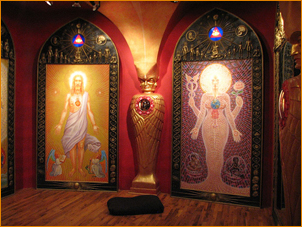
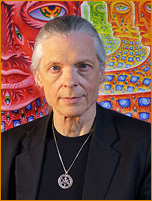 Alex Grey is an American visionary artist, author, teacher, and Vajrayana practitioner. His body of work spans a variety of forms including performance art, process art, installation art, sculpture, visionary art, and painting. Grey is a member of the Integral Institute. He is also on the board of advisors for the Center for Cognitive Liberty and Ethics, and is the Chair of Wisdom University's Sacred Art Department. He and his wife Allyson Grey are the co-founders of The Chapel of Sacred Mirrors (CoSM), a non-profit church supporting Visionary Culture in Wappingers Falls, New York.
 Jonathan
Talat Phillips (in The
Huffington Post) writes this about Alex Grey:
Jonathan
Talat Phillips (in The
Huffington Post) writes this about Alex Grey:
[From a testimonial by Alex Grey:]
I've been inspired by Adi Da's writings for many years. He is a contemporary spiritual Hero, offering his transcendental gifts to a culture without a tradition for or even "taste" for Avatars . . . yet he bears the burdens of sagehood with persistence and love.
[Reprinted from Alex Grey's official website:]
Seeing the Master, or glimpsing an enlightened being, is called darshan, during which a subtle transmission can occur to bless or empower an aspirant's spiritual development. It was during such a circumstance that I met the heart master, Adi Da.
One of the remarkable things about this spiritual meeting was that afterward I realized that no thoughts or concepts had occurred in my mind during the entire time Da was present. There is only the Divine Presence that he is and all of us potentially are. He seemed silently to become every individual in the room, and as this happened, people swooned in devotional ecstasy.
My one encounter with Adi Da was profound. I am not a formal devotee, but I have tremendous respect for Da's writings and teachings.
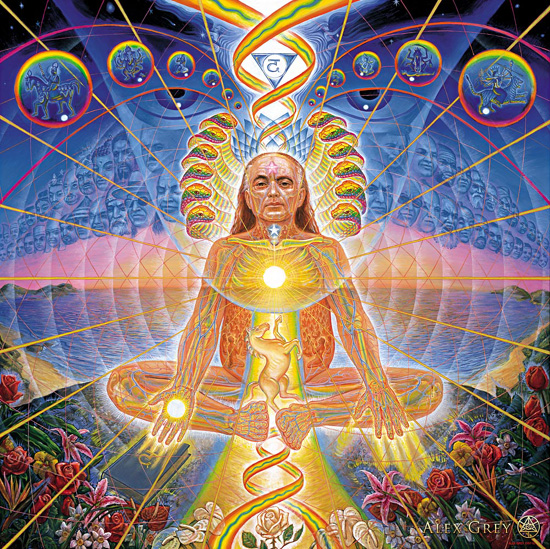
Based on his Darshan of Adi Da, Alex Grey created a painting of Adi Da. He writes about that painting below.
© Alex Grey
In my painting Adi Da, the guru is portrayed as a totally transfigured being. His heart is the dawning sun, source of illumination outwardly and inwardly symbolic of Da's transparency to Divine Radiance. Since Da mean "the giver", the right hand is making an offering of teachings that contain the same light as the heart. A lineage of masters from various wisdom paths are receding translucently into the horizon of the top row of heads; the heads in the bottom row are the various faces of Adi Da, from childhood up to the present. The sky meets the ocean at heart level, and a pillar of light connects the heavens and earthly realms through the central channel. The Dawn Horse in the central channel symbolizes the force that powers Adi Da's teachings. There are many devotees inside the body. The flowers are an offering to the Master. A large translucent face hovers over his physical form. The large head rests on a central channel of light coming from the bottom of the composition, suggesting the shape of a simple grail-type drinking cup. The potion in the cup is amrita, nectar of the heart united with an ocean of love, the God intoxication that the guru provides and for which humanity thirsts. The bright "Godhead" has large eyes and its mouth is placed at the shoulders, shouldering the mouth of God, and Da's head becomes the God nose/knows.
[Adi Da's] way of teaching was simply to be present for his devotees' contemplation. This is why images of deities and avatars are important to some religious cultures. One of the most important Tantric spiritual practices is called Guru-Yoga. Guru-Yoga is a method of visualization in which the aspirant imaginatively works with an image of a spiritual master as a crystallization of spiritual potential, a psychic "attractor" from which one receives specific empowerment. This process draws on the powerful inner archetype of the "master", one who has gone beyond the normal human limitations and achieved transcendent greatness or enlightenment. For most people this is a suppressed archetype, so bringing it to full consciousness and being empowered by its presence establishes an important bonding and reinforcement of one's identity with an internal spiritual reality. By clearly representing a spiritual archetype, artworks can serve and catalyze the viewer's own realization. Throughout the history of art, a similar principle has been used to transmit the power of religious people through their portraiture.