Adidam
and Music
The
best music draws attention directly to the Spiritual Reality. That is what makes
it enjoyable. Avatar Adi Da Samraj |
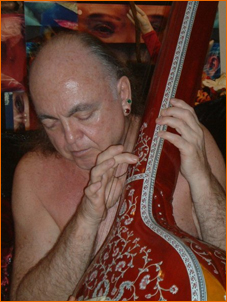
Ed. Note: Adi Da playing the tamboura (in the above picture)
is one of the rare occasions where He "used His own hands"
to play music (rather than using
the hands of His musician devotees). The recording of this
extraordinary occasion is available on the audio cassette, Nada
Dhyananta. The CD, Da
Mahamantra, combines Adi Da's tamboura playing with His chanting
of one of the Mahamantras: "Om Ma Da".

This
section is about all the different roles music has played (and continues to play)
in Adidam. It is organized as follows: - Diverse
Devotional Music with a Common Inspiration
- A
Culture of Invocation
- Name and Mantra Invocation
- Chanting
as a Discipline
- Swadhyaya Chanting
- Ordinary
Chanting versus Kirtan
- Drawing Upon Traditional
Musical Genres and Creating New Ones
- Musical Settings
for the Poetry, Literature, and Leelas of Adidam
- More Examples of Adidam Music
- Sacred Offerings
and Chanting Occasions
- Music as Sacred Art and
Means for Growing in the Relationship to Adi Da
- Participate
in a Sacred Musical Occasion
1. The Restoration of a Culture of Sacred Music
Virtually
all music these days is secular in both character and purpose. We might listen
to it on our iPod to "escape" from the world around us. We might use
it to stimulate us: by itself, or as we work, eat, exercise, or have sex. We might use it
to channel and release pent-up emotions, or relieve stress, or help us fall asleep at night. Or it might be part
of a shared social context — which might include participation through singing
or dancing — that makes us feel a part of a social group (an ethnic or religious
group, a group dedicated to a social cause, etc.).
All these ordinary uses of music have their place in ordinary
life. But in many traditional cultures (and even earlier in the
history of Western civilization), music was not exclusively
(or even mostly) dedicated to materialistic or social purposes.[1]
It was primarily created to serve a higher purpose: a sacred purpose.
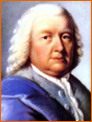
| The
aim and final end of all music should be none other than the glory of God and
the refreshment of the soul. Johann Sebastian Bach |
With
Bach, and composers previous to Bach, we can talk of the sacred, of music and
musical form that evokes some feeling of orientation to the Divine, and toward
an aesthetic expression that transcends mere human content. Haydn and Mozart are
transitional figures in an event in the West of historical significance. It was
the turning from a Godward culture to an ego-assertive culture, or from the sacred
to a secular culture. This kind of change could be seen in music, but it was also
seen in all of the arts, and also in politics and even in religion. In the West
this is so, and it is also becoming more and more true of the entire world. I
am here to serve in a time when the effects of this change have become potentially
devastating for the world as a whole. It is time to make much of the sacred, and
deal with the past with much more discrimination. Avatar
Adi Da Samraj
June 28, 1989 |
And so, to this end, Adi
Da has integrated sacred music in many different parts of the new culture of Adidam
that He has created. As you will discover throughout this section, the result
is an extraordinarily rich new musical tradition that supports a culture purposed
toward Divine Communion.
 One
of [Adi Da's] great missions relative to human civilization is to restore the
deep purpose of art — art in all forms: visual art, literary art, musical art,
architecture — all of that can be made to support the life of resort to the Divine,
the life of Communion with the Divine. . . . He has encouraged all of His devotees
to create beautiful environments, to create beautiful music, to create beautiful
artistic works. One
of [Adi Da's] great missions relative to human civilization is to restore the
deep purpose of art — art in all forms: visual art, literary art, musical art,
architecture — all of that can be made to support the life of resort to the Divine,
the life of Communion with the Divine. . . . He has encouraged all of His devotees
to create beautiful environments, to create beautiful music, to create beautiful
artistic works.
Jonathan
Condit
(Adi Da's chief editorial assistant) |
Music is a cultural device to sensitize people to the physical and emotional dimensions of their existence, so as to realize
a feeling of balance and well-being. . .
Music is a way of tuning in to the elemental harmony of the natural world, and the process of music has its own laws, which are the subject of study
in a sacred culture. Fundamentally, the sacred process of composing and making music and the experience of listening to music should take place in the
context of a sacred culture. . .
Neither music nor any other art has anything directly to do with Divine Self-Realization. But, properly used, the arts serve
the sacred culture that is devoted to Divine Self-Realization. The highest and most proper use of the arts is to serve the
sacred culture of those who are devoted to Divine Self-Realization.
Avatar Adi Da Samraj |
2.
Devotional Music as a Regular Element in the Practice of Adidam
Music
moves the heart. This is well-known, even in non-spiritual culture. It is not
surprising, then, that music plays an important role in the culture of the Way
of Adidam (also known as "the Way of the Heart").
 Music
works upon our nervous system, our feeling of life, and creates a symphony out
of our emotion. In other words, a summary of feeling is somehow gestured out of
us through the impact of music, whereas a note-by-note analysis of it would have
no meaning. You cannot somehow find out how music has that emotional effect. It
is more magical, more arbitrary, more free than that. It is not discursive and it is not picture-making. Music undermines your effort to make a picture. It also undermines your effort to make sense, to make meaning and order out of it. So you are left with what it is all reduced to when meaning and pictures are not your capacity. You are left with this emotional impact that seems profound and beautiful, but it is not reducible to meaning. It is reduced to the feeling that you cannot put on the page. Music
works upon our nervous system, our feeling of life, and creates a symphony out
of our emotion. In other words, a summary of feeling is somehow gestured out of
us through the impact of music, whereas a note-by-note analysis of it would have
no meaning. You cannot somehow find out how music has that emotional effect. It
is more magical, more arbitrary, more free than that. It is not discursive and it is not picture-making. Music undermines your effort to make a picture. It also undermines your effort to make sense, to make meaning and order out of it. So you are left with what it is all reduced to when meaning and pictures are not your capacity. You are left with this emotional impact that seems profound and beautiful, but it is not reducible to meaning. It is reduced to the feeling that you cannot put on the page.
Avatar
Adi Da Samraj
February 17, 1983 |
2.1.
Diverse Devotional Music with a Common Inspiration
Throughout the years (since Adi Da began the culture of Adidam
in 1972), the devotional music used for chanting — or, more generally,
as a devotional expression of musically creative devotees, whether
used for chanting or not — has been remarkably diverse.[2]
To a great degree, this is because Adi Da's approach to it was
an ongoing, highly experimental consideration, that continued
right up to His Divine
Mahasamadhi, and which His devotees continue now, after His
human lifetime.
The
music of Adidam draws upon many musical genres and instruments, from the oldest
to the newest, from the most traditional (tablas and didgeridoos) to the most technically sophisticated
(electronic synthesizers of all kinds). 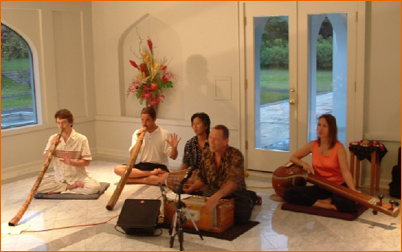
| swadhyaya chanting with didgeridoos, tamboura, and harmonium
Da Love-Ananda Mahal |
Some
pieces are highly scripted, while others are improvisational. Some are contemplative,
while others are energetic, often depending on the context in which the piece
is being used. Some are set to words by Adi Da, while others contain lyrics written
by the composer. What do all these forms of devotional music have in common?
They all are devotional responses to the Divine Presence of Adi Da Samraj. For
this reason, Adi Da directed devotees in a wide variety of musical experiments,
to see what would actually work to magnify the devotional response to Him. Music
speaks for itself. For this reason, we've provided you with a few musical samples
in the following sections. Click the links marked  to hear the individual pieces. Or scroll down the page a bit and listen to them
all together, using our Music Player, to participate
in a Sacred Musical Occasion.
to hear the individual pieces. Or scroll down the page a bit and listen to them
all together, using our Music Player, to participate
in a Sacred Musical Occasion. These samples are just a small taste of all
the devotional music that has been created in Adidam over the years.
2.2.
A Culture of Invocation
Adi Da has described Adidam as "a culture of invocation".
The practice is all about recognizing and invoking Him in every
moment, ever more profoundly.[3] For
this reason, we always begin our formal cultural occasions with
a specific Invocation ("The First Great Invocation") and close with another
Invocation ("The Second Great Invocation" or one of the Sat-Guru-Naama
Mantras).
Because Adidam is a culture of Invocation, many of our musical
compositions are created as Invocations of Adi Da, as in the following example.
2.3.
Name and Mantra Invocation
In the great spiritual traditions, it was always understood
that reciting or chanting the Names of God or one's Guru had a
special "mantric" Force, beyond the communication of
the words themselves. Adi Da has confirmed this, and for this
reason, many of our chants focus on His Names, as a potent means
for Invoking Him.[7]
| [In the] Reality-Way of Adidam Ruchiradam,
chant, rather than song, is the principal mode of vocal Invocation of Me, or the
active exercise of worship in devotional recognition-response
to Me. In the Reality-Way of Adidam, chant is continuous Invocation of Me via
My Divine Avataric Names. Such Invocation steadies and purifies the body-mind-complex.
Avatar Adi Da Samraj |
The musical
style through which this is done can vary widely, as the following two examples
illustrate.
2.4.
Chanting as a Discipline
Adi Da's time in human form is
now over. But because He is eternally
present, the practice of devotional chanting to Him remains as powerful a
means as ever for serving the connection with Him and the magnification of devotion
to Him. Like all the other forms of whole bodily engaged devotional activity,
chanting serves the purpose of turning all the faculties of the body-mind (attention,
feeling, body, and breath) to Adi Da Samraj, in a single heart-based gesture of
devotional response:
|
Chant is simply the repeated Invocation of Me via the
Names and Mantras I have Given — while keeping the
psycho-physical faculties turned to Me. Therefore, chant
is among the fundamental daily practices for all of My
devotees.
Avatar Adi Da Samraj, The
Sacred Space of Finding Me
Physically
(and Formally) Engaged Sacramental Devotion Involves The
Externalization Of attention Via Intentional Activation
Of the body-mind (or frontal personality). In Contrast
To This, Formal (and Deep) Meditation Involves Progressive
Relinquishment Of physical and other outward-Directed
frontal activity. Generally, daily Practice Of The Way
Of The Heart Should Involve An Appropriately Balanced
(and Formal) Measure Of Meditative and outward-Directed
activities, but Even all outward-Directed activities Are
To Be Realized As Forms Of functionally Expressed Heart-Practice.
Avatar Adi Da Samraj, The
Dawn Horse Testament
People
have to be instructed in devotional chanting in My Company. It is a means for
devotional Contemplation of Me, it is not a sing-along. It is a way to focus attention
on Me and invoke Me and open to and receive My Blessing. It is a devotional practice
of self-surrendering, self-forgetting, and, more and more, self-transcending feeling-Contemplation
of Me. Avatar Adi Da Samraj, August 2, 1993
True devotional chant
in the Reality-Way of Adidam is a practice that transcends the mind.
True devotional chant Invokes Me and turns to Me, and stays steady in that turning to Me.
Thus, in the Reality-Way of Adidam, true devotional chant is a mode of the moment-to-moment practice of whole bodily devotional turning to Me.
You must enter into that Divine Process through right and true practice, and through all the formalities that manifest the ecstasy of devotional Communion with Me.
Avatar Adi Da Samraj, The Sacred Space of Finding Me |
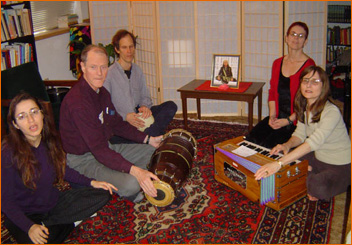
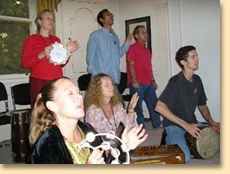
| Devotees
in Seattle, Washington chanting to Adi Da |
Chanting
is a form of practice of the Way of Adidam. You are not supposed to be chanting
to Me to provide a musical atmosphere or entertainment for Me. Chanting is not
done for My benefit. Chanting, like meditation, is a form of your sadhana, and, rightly done, it is a form of feeling-Contemplation
of Me. You do not chant to entertain or amuse Me. You chant as a means to feelingly
Contemplate Me. Chanting is not to be done self-consciously, as if you are
listening to your own voice. However, I have noticed self-conscious articulation,
obvious attention to correct pronunciation, and the attitude of performance. When
done properly, a chant is harmonious and it has an agreeable sign, not, however,
as a result of your being self-conscious about your voice. It is not even a matter
of your listening to the chant, since awareness of the chant is a very peripheral
aspect of chanting. You are not to be preoccupied with the musical or vocal aspects
of the chanting . . . I have also noticed that in some people, chanting
seems superficial. Some are just looking at the scene around Me. Attention in
them is scattered, and that is not the proper disposition for chanting. When you
are chanting, you should hold attention to Me, not staring at Me, but feeling
Me. If chanting is occuring in My physical Company, you should keep attention
on My bodily (human) Form. If it is not done in My physical Presence, then you
should keep attention on My Murti. Do not let attention, or mind, fall back on
the ego-self or wander. Avatar Adi Da Samraj, September 13,
1991 |
2.5.
Swadhyaya Chanting
Swadhyaya chanting — the musical recitation
of sacred texts — is both a longstanding tradition, and an important practice
in the Way of Adidam. Adi Da has emphasized many times that listening to His recited
Word can have a far greater (whole bodily) impact than simply sight-reading His
Word on the page (or the Web).
He also evolved a particular musical form
for swadhyaya chanting:
Traditionally
in India, the Guru
Gita and other recitations are sung in this manner of a very
simple, few-note melody in order to allow for a deeper reception of the Sacred
Text. . . . I've established (years ago) a format for that, for the chanting and
recitation of My Teaching Word. . . . that may have a repetitive, several line
form. Avatar Adi Da Samraj, April 27, 2005 |
The
specific musical "repetitive, several line form" with the "very simple,
few-note melody" used for swadhyaya chanting in Adidam is illustrated in the following
example.
2.6.
Ordinary Chanting versus Kirtan Devotional singing, particularly in
the form of kirtan, is particularly useful if one tends to be
"in one's head" (rather than being fully, whole bodily incarnated),
or if one has difficulty feeling.
If
you are too rigid to express your devotion to Me, you should be breaking through
that rigidity by engaging more in demonstratively expressive devotional practices
(such as pujas, full feeling-prostrations, chanting, and all the forms
of ecstatic devotional singing, including vigorous kirtan). . . . If you
are to transcend your presumptuous ego, you must animate your devotion to Me.
Devotion to Me is something you must do. Avatar Adi
Da Samraj
"Throw your body to the Floor, and Yield your Heart"
The
Love-Ananda Gita |
Adi Da distinguishes ordinary
chanting from kirtan in the following way:
There
is a difference between chanting and kirtan. Kirtan is when you use a song and
chant in a rhythmic, musical manner in which people are very active — sometimes
rising up from their seat, dancing and jumping and spontaneously being moved.
Chant, on the other hand, is different. It is quieter in tone, and it is musically
less elaborate and less rhythmic. It is, instead, repetitive. It is made up of
repetitive lines, even words that are repeated over and over again called by a
chant leader. It does not, in general, suggest the kinds of responsiveness as
in a kirtan. It is not physically motivating. People, of course, may make sounds
or kriyas, but, in general, it is more calming. When chants are being done,
they should be done for an extended period of time repetitively, whereas, in kirtan
there can be several songs and chants done — not in a repetitive fashion, for
brief periods of time. People look for chants to be bodily and vocally interesting.
The chanting mode is not interesting. It is calming and conducive to dropping
bodily and mental activity in a calmer sense. Avatar Adi Da
Samraj, March 26, 1992 |
2.7.
Drawing Upon Traditional Musical Genres and Creating New Ones
Adi Da
has always encouraged the musicians of Adidam to study and draw upon a wide variety
of devotional music traditions, as well as experiment with creating new musical
genres.
And
it's not just about imitating traditional modes of it either. If there are people
creative with music, they can come up with new forms unique to Adidam. Avatar
Adi Da Samraj, April 27, 2005 |
The purpose behind this
was not the conventional one of idolizing variety or novelty in art for its own sake. Rather,
the point was to study, learn from, and build upon time-tested means for magnifying
devotional expression; and to evolve new forms of musical expression most suited
to a new and unprecedented Spiritual Revelation.
The Indian tradition of sacred music — A significant
portion of the music of Adidam has been drawn from or inspired
by traditional Indian devotional chants and other forms of traditional
Indian music. Here are some examples.
 Danavira
— In the experimental Adidam album, Danavira (The Hero
Of Giving), professional jazz composer, John
Mackay, drew from a wide variety of musical genres —
from Gregorian Chant to Christmas carols — in creating
new forms of Adidam devotional music. Danavira
— In the experimental Adidam album, Danavira (The Hero
Of Giving), professional jazz composer, John
Mackay, drew from a wide variety of musical genres —
from Gregorian Chant to Christmas carols — in creating
new forms of Adidam devotional music.
| Rejoice
— a choral piece that draws from the modern tradition of atonal choral works
(Charles Ives and others). | | | | Interlude
— a short instrumental piece drawing on the classical music tradition, with
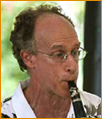
symphony clarinetist Bill Somers playing. | | | | | There
Is Only Light — draws on the Qawwali tradition of Sufi devotional
music (exemplified by Nusrat Fateh Ali Khan). Read Adi Da's appreciation of the
Qawwali musical tradition below. |
Jaya
— On another innovative Adidam album, Jaya,
the musicians experimented with taking traditional Indian devotional chants and
embedding them in the context of "world music". Facing East — The group,
Facing East, led by devotee, John
Wubbenhorst, continually experiments with new musical possibilities that often
seamlessly combine Eastern and Western musical traditions. | 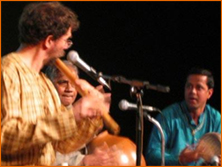 Facing
Beloved — From the album, Facing
Beloved, by group Facing
East, with John Wubbenhorst (bansuri), Subash Chandran (ghatam) and Ganesh
Kumar (kanjira). This piece is based on a melody from J.S. Bach (siciliano) with
elements of Raga Kirwani. |
2.8.
Not Getting with the Program (or self): Improvisation and self-Transcendence
in the Music of Adidam
Because the whole point of music in Adidam is
to magnify the devotional response to Him, Adi Da was always sensitive to when
the musical expression of devotees would become rigid, programmatic, "institutionalized", boring,
or automatic in its expression, undermining its purpose.
[In
1973, Adi Da and devotee Gerald Sheinfeld travelled
to India. These comments were from a period when they were visiting a traditional
Indian Ashram they are visiting.] Gerald Sheinfeld: The
first couple of days we attended all the chanting meetings, about four each day.
When we found out which of these were mandatory and attended only those. By the
end of the stay, Bubba [Adi Da] had stopped going to any chanting meetings. He
said that all this chanting was simply a form of "crowd-control." It was the external
representation of the internal sadhana of attention to God.
Adi
Da's further comments:
Chanting has its place as a moment, not as a
perpetual attempt to become absorbed. It is an occasion,
a pleasantry. It's enjoyable from a genuine point-of-view,
but once it becomes repetitive and constant, it is another
method. It should only be used to the degree that it is
natural, functional and appropriate.[6]
| |
[Adi
Da caricaturing devotees talking to each other:] "So what's on the program?
Do we get a Darshan now? What do we do in a Darshan?" "Well,
you bow down. You offer a flower. This is the routine. If you hear somebody chanting,
just imitate that." . . . . I do not want to be confronted by programs.
. . . That's not Adidam. It's not My Teaching. . . It's simply egoic behavior,
and it's taken on an institutional form. . . .That's what passes for a culture
of "Divine involvement" all over the world, in fact. That's what conventional
religiosity does. It creates these substitute performances that really do not
involve the transcending of egoity at all, that are making references to God or
Spiritual teachers or whatever, but they're not about anything at all. True
chant is something else. It's part of a devotional environment of profound contemplation
of Me, that's necessarily associated with a renunciate life. It can't be otherwise
because it's a different kind of concentration than what a non-renunciate life
is about. . . . When you see true devotion exhibited, it's a vision you
can't forget. . . [The singers'] practice has to coincide with the singing,
meaning it's got to be the sign of mature practice, true recognition
of Me, not just "you know how to sing". . . . So those who do chanting as
a service usually have not only training, but they have some disposition toward
it that at least has some level of authenticity. It doesn't mean it's the same
kind of depth motivation in every case, but of course, they have to serve the
gathering, to make the participation of others right, and not just a kind of sing-along.
Really, it's part of something that people should study in the gathering —
everyone. . . . There are "programs" in [other] Ashrams too,
different from place to place. There was a certain level of what you could call
"programs" at Baba Muktananda's Ashram in those early days [when
I was first there]. But it was rather loose in some fundamental sense also.
Avatar Adi Da Samraj
March 7, March 31, April 8, May 12,
May 16, and June 1, 2005 |
Because the ego so frequently falls into programmed behavior,
Adi Da sometimes encouraged musicians capable of it to engage
in musical improvisation — particularly when playing
music for Him — so that they could stay loose and open in
their feeling-expression. Based on recognition
of Adi Da as the Divine Person, such improvisation is, Adi
Da says, a kind of spontaneous "exclamation".[4]
Without such recognition:
.
. . they don't exclaim. They don't recognize Me. . . . It's formulas of speech.
. . . It's not recognition speaking [or singing, or playing] to Me. Avatar
Adi Da Samraj
April 12, 2005 |
Are you counting up
all My Sayings so you can remember what to do? I told you "It" Is My House. All you have to do Is
heart-recognize Me. And, the next thing you know, you Are in My House, singing to Me.
Avatar Adi Da Samraj
"The Concave Cube Of Normals To The Curve,
Or, A Horse Appears In The Wild Is Always Already The Case"
The Happenine Book |
Devotional, musical improvisation
in Adidam is always a matter of staying turned to Adi Da, and not falling into
either the pitfall of programmed musical expression or the pitfall of egoic
"self"-expression. Adi Da describes this second pitfall:
People
can get off the wall with [chanting], and self-involved and wrapped up in crazy
behaviors — that's possible too. Avatar Adi Da Samraj
May
17, 2005 |
Anciently,
all arts were forms of ritual. The artist submitted to a master of his or her
craft or art, by whom he or she would be schooled in the culture — in other words,
the tradition, the limits, the techniques, the purposes of the art. By submitting
to this demand of the culture in general, the artist transcended his or her own
ego-possessed motivation. An artist was not permitted to paint, sing, or play
an instrument until the master could attest to the artist's preparation and affirm
that he or she was capable of serving the community, serving the culture. The
artist was capable of this because not only had he or she learned all the techniques
— not only did the artist know how to awaken in his or her audience all the imagery
to which they were devoted and by which they might transcend themselves — but
the artist had mastered himself or herself in the process. In modern time,
the arts have ceased to have a cultural purpose that is acknowledged to be necessary.
The arts become mere entertainments. The arts become ways of expressing
yourself, your contents, your insides — your aberrations. In fact, the arts become
the very means for expressing the problems you have, because there is no culture,
no center, no society, no necessity to what you do — the failure of the social
order, the failure of the demands within an artistic discipline that you transcend
yourself, that you master yourself, that you provide something within the social
order that is valued by others, that has intrinsic value, that has fundamental
value, that is not just decorative or entertaining, but that is part of the sacred
purpose of the community. Find a way to submit yourself to the function
of art within the true culture of Adidam Ruchiradam. That is how you will transcend
yourself in this process and make your art more than ego-possession, "self"-expression,
Narcissistic "self"-reflection. Find a way for your art to be ecstatic
and find some way for it to serve, even in ordinary ways. Give pleasure through
it and have that pleasure serve the appropriate mood of devotees. And then, perhaps,
find some higher purpose — find a way for your art to be ecstatic in the Spiritual
sense. That is a discipline. Perhaps, it will take a long time to do that.
But one's struggle is not to fulfill oneself and make that "self" lovable
by the "world". The struggle is to transcend oneself in order to enter fully into
the Divine. Avatar Adi Da Samraj
September 17, 1980 |
You
can tell when improvised sacred music is not falling into the pitfall of egoic
"self"-expression because it is turning the listener to the Divine,
rather than to the performer or to the form of the music. Someone being
musically expressive or improvising in an egoless fashion, while turned to the
Divine, is not a blank slate. Rather, he or she is creating in accord with the
aesthetics of Reality Itself, and is doing so in full relationship with any other
musicians improvising with them. Here is one of the most succinct summaries Adi
Da has ever given of the aesthetics of sacred, ego-transcending art of
all kinds, including sacred music:
My
true devotees give living human form to the Indivisible Presence of Reality Itself
. . . My true devotees "create" according to the aesthetic logic of
Reality and Truth, and (thus) they turn all of their living into limitless relatedness
and true enjoyment. They constantly remove the effects of separative existence
and restore the inherent form of things. They engineer every kind of stability
and intrinsic beauty. They give living human form to My Avatarically Self-Transmitted
Divine Transcendental Spiritual Presence of Love-Bliss and Infinite Peace. Their
eye [or ear] is always on the integrity of inherent form, and not on egoically
fabricated (and, necessarily, false and exaggerated) notions of artifice. Their
sense of form is always integrated, stable and whole, and always in present-time,
rather than gesturing toward some "other" event. Avatar
Adi Da Samraj
"I Have Come To Found A Bright New Order of Global Humankind"
Part
25, The
Aletheon |
"Baba Da's Great Tradition Improvisation
Orchestra" was an experiment in improvisational devotional music directly
encouraged by Adi Da in the musicians who were playing for Him. As one of them
put it, "There was no plan except to play for our Beloved Guru in the great joy
of His Presence."
2.9.
Musical Settings for the Poetry, Literature, and Leelas of Adidam
Over
the years, Adi Da has written poetry, literature, and evocative sacred texts that
naturally lend themselves to musical composition and innovation. Crazy
Da Must Sing — This
book of Adi Da's poetry was published in 1982, and devotee musicians have
been setting its poems to music ever since.
| | |
|
 I
am as one — Adi Da's poem, "I am as one who left his home to do
a thing for man", set to music by Ray
Lynch. Sung by Crane
Kirkbride, on his album, An
Infinite Well. I
am as one — Adi Da's poem, "I am as one who left his home to do
a thing for man", set to music by Ray
Lynch. Sung by Crane
Kirkbride, on his album, An
Infinite Well.
|
| | |
|
 My loved one sits upon my knee — Adi Da's poem, "My loved one sits upon my knee", set to music and sung by Pauline Chew, on her album, Songs for Baba Da. . . and the World. My loved one sits upon my knee — Adi Da's poem, "My loved one sits upon my knee", set to music and sung by Pauline Chew, on her album, Songs for Baba Da. . . and the World.
|
| | |
| | other
examples — "Mornings, No", "Forehead, Breath, and Smile",
and "When Things Have Left Him" from Eyes
In Other Worlds; "I’ve Grown Used To Miracles" and "I Am As
One Who Left His Home" from the album, A
World More Light. |  The
Mummery Book — The Mummery Book
(Book One of Adi Da's Orpheum trilogy) is a sacred theatrical enactment
that combines acting, images, and music. Much music has been written for The
Mummery Book over the years, often completely new with each year's performance.
Here is just a small sample, composed and sung by Chris
Tong for Adi Da at the 1995 performance of The
Mummery Book on Naitauba, Fiji. The
Mummery Book — The Mummery Book
(Book One of Adi Da's Orpheum trilogy) is a sacred theatrical enactment
that combines acting, images, and music. Much music has been written for The
Mummery Book over the years, often completely new with each year's performance.
Here is just a small sample, composed and sung by Chris
Tong for Adi Da at the 1995 performance of The
Mummery Book on Naitauba, Fiji.
Leelas — The world's religious traditions
are full of religious stories being set to music: from Christmas carols, to Passions (e.g., Matthew's Passion), Easter hymns, and Pesach music in the West, to the tradition of Harikata in the East: a form of Hindu religious discourse in which the storyteller explores a religious theme, usually the life of a saint or a story from a religious epic using
stories, poetry, music, drama, dance, and philosophy. Adi Da has also
recommended that the leelas of Adidam be set to music and dramatized (particularly
for instructing children being raised in the culture of Adidam):
It's
the application of the arts, sacred theater and so on to communication of leelas
and instructional texts. And it should be done on a regular basis in all the regions.
. . Plus, there are other texts to be recited or dramatized, sometimes put to
some kind of musical setting for the recitation, or the words themselves chanted
or recited in a kind of musical manner. Leelas dramatized. The arts have got to
be brought to these matters for children and adults, a regular part of the sacred
domain. Avatar Adi Da Samraj, April 14, 2005 |
2.10.
More Examples of Adidam Music
|
|
|
|
|
|
|
|
|
| |
|
 Ray:
My relationship with Adi Da Samraj over more than
25 years has only confirmed His Realization and
the Truth of His impeccable Teaching. He is much
more than simply an inspiration for my music,
but is really a living demonstration that perfect
transcendence is actually possible. This is both
a great relief and a great challenge. Ray:
My relationship with Adi Da Samraj over more than
25 years has only confirmed His Realization and
the Truth of His impeccable Teaching. He is much
more than simply an inspiration for my music,
but is really a living demonstration that perfect
transcendence is actually possible. This is both
a great relief and a great challenge.
|
| |
|
|
|
Ray sings with Adi Da
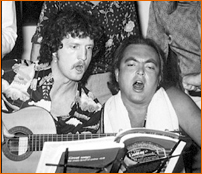
(1975)
|
|
|
|
|
|
|
|
|
|
|
| |
|
|
| |
|
Crane and Adi Da singing "I Am
Who You Are" (1992)
|
|
|
|
|
|
|
|
|
Naitauba,
Naitauba
Composed by Jeff Hughes, played and
sung by Alexandra Fry, singing about the Spiritual
purpose of the island of Naitauba. (The words of the
song are "in Adi Da's voice" — in
other words, they are written as though He Himself
is speaking about Naitauba, but He never actually
spoke these particular words.)
|
|
|
|
|
|
Many talented and creative musicians have created the full
body of devotional music in Adidam to date.[2] Only some
have been mentioned or represented in the above examples.
2.11.
Sacred Offerings and Chanting Occasions In addition to music
created specifically for the devotional context of Adidam, many traditional pieces
(Western and Eastern) have been performed for Adi Da in the context of a Sacred
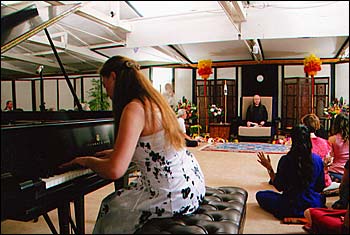
Offering. This was a specific way through which devotees with musical talents
could deepen their relationship with their Spiritual Master, in person. Sacred
Offerings continue after Adi Da's human lifetime, offered by devotees to Adi Da's
eternally accessible Divine Presence.
All devotees, musicians and non-musicians alike, have been able
to express their devotion through music by participating in chanting
occasions where they sang to Adi Da, as in the occasion in the video
below on June 29, 2005, at The Mountain Of Attention Sanctuary.
2.12. Music as Sacred
Art and Means for Growing in the Relationship to Adi Da
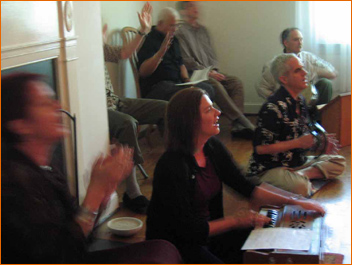
| Devotees
in Washington, DC chanting to Adi Da |
| I play music all the time. I just use someone
else's hands.
Avatar Adi Da Samraj
In the Ruchira Avatara Gita not
every word or line of it is supposed to be the Guru Himself speaking; it's the
voice of the devotee. But the devotee is able to sing rightly about the Guru,
having been inspired by the Guru, so that the Guru in effect is singing the devotee.
Avatar Adi Da Samraj, April 27, 2005 |
All
devotees are called to take up one or more sacred arts, as an integral part of
their practice of the Way of Adidam. Unlike "conventional art", sacred
art is precisely not "self-expression": projecting the contents
of one's ego (generally, one's unconscious) onto canvas if one is a painter, onto
sheet music if one is a musical composer, or into one's singing if one is a singer.
Before all art started being reduced to self-expression in
the last few centuries, there was a shared notion (still intuited by many) that
the best state for an artist to be in was to be "inspired" (a word which
shares a common root with "spirit"), or "possessed" by a Force or Presence
greater than oneself, and to allow one's art to flow from that possession or inspiration. (Done right, one's "Muse" is the source of one's music. "Music" literally means "the art of the Muses".) That
traditional viewpoint is shared by Adidam, and "taken to the limit", in the sense
that the "Force or Presence greater than oneself" is the Very Divine. In Adidam, sacred art
has two aspects: - Its end or purpose is to transport
the viewer (if art) or listener (if music) into the Divine Domain, or at least
help them intuit or connect with It.
- Its means is the artist (if art) or the composer and performers (if music) becoming instruments of the Divine (through contemplation of Adi Da).
In this sense, practicing one's sacred art as a devotee of Adi Da is not different
from what all devotees are called to do as they grow in the practice of Adidam
altogether: to become instrumentality for Adi Da's Spiritual
Transmission — where the means is surrender to the Divine, and the end (from
the Divine Viewpoint) is to magnify the Divine Transmission for the sake of the
Divine Enlightenment of all beings. 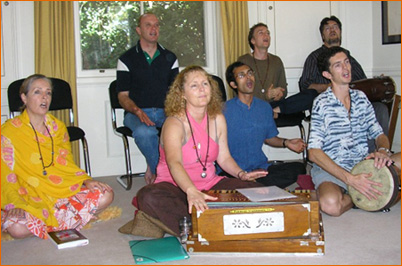
| Devotees
in Melbourne, Australia chanting to Adi Da |
Many
artists, creative people, spiritual Realizers, spiritual seekers, and social activists,
resonate with this notion of becoming instrumentality — of giving oneself over
to something greater than oneself, for a higher purpose than self-fulfillment:
Lord,
make me an instrument of Your peace. St. Francis of Assisi |  |
As
practitioners of the Way of Adidam, we are called to give ourselves over — through
our sacred art and through our practice altogether — to the very Divine, to serve
the Ultimate Purpose of the Divine Enlightenment of all beings, through our becoming
instrumentality for the Divine.
To grow in one's sacred art certainly involves becoming
more proficient in all the technical dimensions of that art. If
one's sacred art is chanting, certainly singing off key does not
help the listeners connect with the Divine![5]
In general, lack of proficiency draws everyone's attention to the
deficiency rather than to the Divine. This applies to the chanter's
(or musician's) own attention as well. If one is not highly proficient
technically, then much of one's attention will be going toward "getting
it right", and there will be that much less free attention
to devote to the Divine.
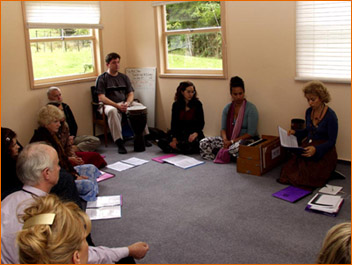
| Antonina
Randazzo leading a chanting seminar in New Zealand |
But
growing in one's sacred art is only secondarily a matter of technical mastery.
Primarily, it coincides with growth in one's devotional practice and one's ability
to invoke Adi Da as the Divine. The key then is to have enough free energy and
attention to invoke Adi Da, so that one is practicing one's art in the self-forgetting,
Him-remembering disposition.
It
is important to understand that the matter of sacred art is a profound discipline.
In the conventional setting, to be an artist, you must be technically competent
and creatively enthusiastic. In the sacred context, though, you must also, at
the very least, be someone who is really doing sadhana and be active from the
real depth of devotional Contemplation. In sacred art, you are required to press
beyond your usual tendencies, what you are assuming yourself to be all the time,
and all of your presumed limitations . . . The doing of sacred art requires not
only full capability and competence relative to the technicalities of the art
and real creativity of course, but the performance of sacred art requires the
fullest development of sadhana and submission to the Divine.
Avatar Adi Da Samraj
You
have to understand that sacred music is not a performance. It is not about how
good you can do it. It is a sadhana. Chanting and sacred offerings occasions are
not for the individuals who are actually making the vocal [or other musical] offering:
these occasions are for everyone else there as well. The person making the offering
has to be very sensitive to the fact that it is his or her function to make a
devotional offering and pull everyone into making that offering to Me. The offering
and chant being done have to effectively do that, so that everyone is participating.
Really, the person making the offering becomes invisible. . . . These offerings
are participatory occasions in devotion to Me. Avatar Adi
Da Samraj, May 2, 1992
It is presumed that those participating [in a Sacred Music Offering] will be entering into Divine ecstasy. That is the whole purpose of the music, to serve the ecstasy of all present.
Avatar Adi Da Samraj
|
When performing music is our sacred art, we
not only master a musical instrument; we also allow the Divine to master our body-mind,
and transform it into an instrument that the Divine can play. 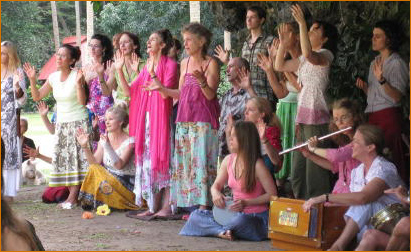
| Devotees
in Adi Da Samrajashram chanting to Adi Da |
On
the Celebration of Adi Da's Jayanthi [birthday] in 1993, devotees were invited
to a sacred performance offered to Adi Da by the music guild at Adi Da Samrajashram.
Before the musicians began to play their instruments, Adi Da inspired them with
instruction relative to sacred art and its traditional origins:
For
those of you who are going to celebrate the sadhana of music here tonight, do
so in this spirit. Do it as a means of ecstasy, not self-conscious, full of thought,
but as devotion to Me, beyond thought, to become ecstatic and to serve all your
fellow devotees here in their ecstasy, their movement beyond themselves. Do not
allow it to be a concert with boring middle-class people watching or listening,
while you, as boring middle-class people, sing or make music, sounds of one kind
or another, and everybody contributes another $50 to the Ladies Music Society
at the end, you see! Do not let it be that. Make it more like what in the Sufi
tradition of Islam is called "Qawwali". Those who perform music
in the Qawwali tradition observe all those participating. It is presumed that
those participating, just sitting while others play and sing and so on, wiill
be entering into Divine ecstasy. That is the whole point, that is why they do
the music, but they observe everyone present. If someone enters into ecstasy during
a particular passage in the music, in the song, with the instruments or whatever,
the musicians observe the discipline of continuing with that until the person
comes out of it. If they are somehow the cause of that ecstasy, they must serve
it until the person returns to a more normal attitude. So the musicians are there
to serve the ecstasy of all present, and they observe the discipline of observing
[the participants] to serve in that process, and will not leave them, will not
break off, saying, "Well, we have had five minutes of music and that's the
end of it." No, they just go on and on until everybody who has gone into
the fullest ecstasy has done so and come back and resumed their normality. You
Westerners have this concert mentality, egos getting up to be praised for their
performance. Music, from the traditional point of view, is only for ecstasy,
only for self-transcendence in Divine Communion. Music is a means for it in the
context of the whole culture of Divine Communion, which everybody knows about
and is practicing as well. But that is the point, that is what they are there
to serve. They will not interrupt it or stop it as long as people are in that
ecstasy. So they do not do "concerts" in the sacred traditions.
They do not expect praise. They are not there as egos expecting to be honored
and so forth. Honors are given, of course, but that is not the point. The point
is God-Communion. That is the traditional point of view of the arts. And they
are there to serve that in everyone and through these unique means, which are
part of the collective culture which adds something to the daily practice of every
individual, provides occasions of this unique means of Divine Communion. It is
not ego games, it is not a mere concert, it is not a civilized performance. It
is just to enhance what everyone is struggling to do every moment, which is to
enter into most direct Communion with the Divine and lose egoic self in order
to do so. You are here to serve My devotees, their Communion with Me, their
going beyond themselves. Be sensitive to them in the process. You, yourselves,
enter into it without self-consciousness. The notes are not the point. They are
not an end in themselves, they are strictly, or only, means. You are not here
to be praised or accepted, you are here to serve My devotees in My Company, to
ecstatically be in My Company through this unique service at this moment. Avatar
Adi Da Samraj, November 3, 1993 |
So in addition to technical
mastery of voice or musical instruments, and in addition to one's personal expression
of devotion through the music, the sacred musical performer must also become adept
at using his or her craft to help draw out the devotional participation of everyone
else in the room:
In
a secular situation, the focus is on the performance and on the ego. In the sacred
situation, the focus is on the Divine, on the Realizer. The Realizer or the Divine
is the subject of devotion. Therefore, this requires self-transcendence, not self-presentation.
This is the most difficult aspect of the art to learn and it requires maturing
in the process. These offerings are participatory occasions in devotion to Me.
Part of the training is to be able to perform in these sacred occasions and this
requires great skill in order to provoke participation on the part of everyone.
These occasions are not just for the person making the devotional offering to
express his or her own devotion. Avatar Adi Da Samraj |
|
|
|
|
|
|
|
|
|
|
Singing
Opera with Adi Da
— During His years of face-to-face
Teaching Work, Bhagavan Adi Da used singing opera
with His devotees as a skillful means that drew those
present into selfless feeling-ecstasy. Longtime devotees
Aniello Panico and Roger Ohlsen describe what that
was like.
|
|
|
|
| |
|
|
| |
|
|
| |
|
|
| |
|
|
|
I
Realized That I Was "Playing for God" — In the
early 1980s, Bill Somers had already realized what
he had held to be his life's ambition: to be principal
clarinetist in a symphony orchestra. But this accomplishment
was not enough for Bill, after all; his heart was
not satisfied. And that was a good place to be! It
led him to his Spiritual Master.
Bill
Playing "Interlude"
|
|
| |
|
|
|
|
| |
|
"This
is the God for me!" — In this radio interview
(with Aaron Joy), rock musician Theo Cedar Jones describes
how he became Adi Da's devotee; how Adi Da transformed
his entire manner of singing and his craft of songwriting;
and the creative challenge of communicating Adi Da's
Presence and Teaching through the medium of rock.
|
|
|
|
|
|
|
|
|
|
3. Participate
in a Sacred Musical Occasion
Enjoy over an hour of the devotional music of Adidam
— you can listen to most of the examples presented above in our Music Player
below.
We have organized it as a Sacred Occasion. First, while you are
settling into your seat, Baba Da's Great Tradition Improvisation Fusion Orchestra
plays some transitional music to help transport you into the Sacred context. Then
Antonina Randazzo provides a formal Invocation of Adi Da. All the subsequent pieces
continue to magnify that Invocation, reflecting in many ways upon Who and What
Adi Da Is — the Wonder, the Blessing-Power, and the Happiness of the Divine
appearing in the world in human form — as well as the nature of egoity ("May
Your Radiant 'Bright' Blessings Awaken me, whose eyes are covered over by the
images of a separate self") and of Reality Itself. On the more lively tracks,
feel free to get out of your seat and "Dance
Down The Light"! The Sacred Occasion closes in the way devotees of
Adi Da often close their weekly Guruvara occasions: with the singing of Gurudeva Hamaaraa
Pyaaraa ("To Our Beloved Guru"), and closing with the recitation of the Sat-Guru-Naama Mantra.
To start playing the playlist, press p. Press q to pause, and p to start again. Press a track description to switch to that track. If you press a track that is already playing it will pause. If you press it again, it will play. When a track is playing, you can change where you are playing in the track by moving the slider on the progress bar. The k button moves to the next track. The j button moves to the previous track. Pressing the D to the right of the track will open a new browser tab playing the MP3 audio file. Pressing the i to the right of the track will open a page with more information.
FOOTNOTES
|



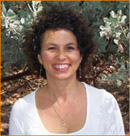
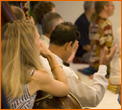 Devotional
invocation
Devotional
invocation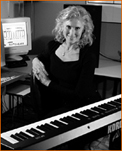 Om
Sri Da (excerpt)
Om
Sri Da (excerpt) Ruchira
Avatara Gita (The Avataric Way Of The Divine Heart-Master)
Ruchira
Avatara Gita (The Avataric Way Of The Divine Heart-Master)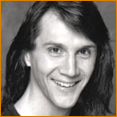
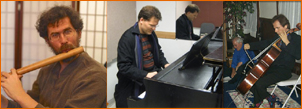 Baba
Da's Great Tradition Improvisation Fusion Orchestra
Baba
Da's Great Tradition Improvisation Fusion Orchestra