Finding
Adi Da > Chris Tong > Part III (Serving the Adidam Mission) > Chapter 2
Finding
Adi Da > Chris Tong > Part III (Serving the Adidam Mission) > Chapter 2
2. Creating and Developing
the Early Adidam Web Mission (1994-1997)

(Click image to enlarge)
|
|
| This is part III, chapter 2 of Chris Tong's story, Finding the Divine In Person and Waking Up From the Dream. | |
|
|
Looking back at my life, I seem to have had a facility for sensing in advance, and associating myself with, great breakthroughs that had the potential to transform the world. I sensed that about Artificial Intelligence in 1980, when I decided to make AI my field of specialization in Computer Science, 42 years before AI exploded onto the world stage in 2022, in the form of ChatGPT. I sensed it about Avatar Adi Da Samraj, which would lead me to become His devotee in 1989, and do everything I could to serve His Work of liberating all beings. And I sensed it about the Web in 1993.
In 1993, I was still a professor of Computer Science at Rutgers University in New Jersey. At that time, the Web had only been in existence for a couple of years, and there were only about two thousand websites in existence in the entire world. But I instantly grasped the immense potential of websites for communicating Adi Da's Offering to the entire world. The name, "World Wide Web", is very suggestive of that potential. If one's purpose in life is to serve the liberation of all beings, what better tool could there be than the Web, for making large numbers of people aware of an opportunity like the Way of Adidam? Adi Da has said that one of the reasons He chose to be born in this time[6] was the global interconnectedness of the world (which would allow Him to reach everyone). And there is no technology that better exemplifies that global interconnectedness than the Web.
And so I learned everything I could about building websites, and started creating Adidam's first website. Fortunately, because I was a professor in a major Computer Science department, I had access to the Web and to Web technology, even at that early time.[1]
By today's standards (several decades later), that first Adidam website was rather modest! But then so were all the websites at the time, and so was the one browser (called Mosaic) available for viewing them. In writing this chapter, I dug into the Internet Archive and was able to recover and reconstruct the home page of that original site (from 1994), so you can actually see it as I tell this story. (You can click on the image to enlarge it.)
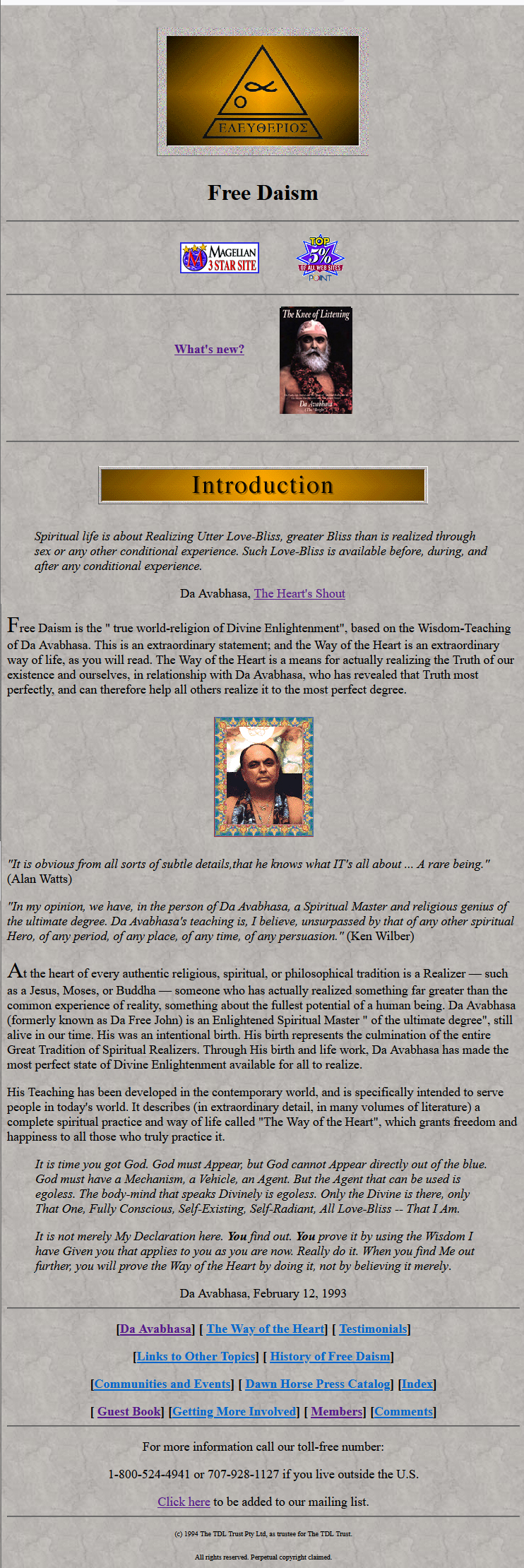
In early 1994, when I launched the site, the names "Adi Da" and "Adidam" did not yet exist. We called Adi Da "Da Avabhasa", the practice, "The Way of the Heart", the religion, "Free Daism" (instead of Adidam), and the trust, "The TDL Trust Pty Ltd" (instead of "The Avataric Samrajya of Adidam"). And so those were the names that appeared on the first website. Similarly, the logos Adi Da developed for Adidam also did not yet exist, so I used the logos that were in use at the time.
Despite the limits of the Web technology available at the time, I wanted the site to provide an introduction to Adi Da and Adidam that was both accessible and comprehensive, and that would give visitors clear next steps to take if their hearts were so moved. So the site had all the essential sections: Da Avabhasa, The Way of the Heart, Testimonials, History, Communities and Events, The Teaching / The Dawn Horse Press,[4] Getting More Involved, etc. The major sections of Adidam's official site have remained essentially the same since then, straight through to the current website. (The site got its current web address, adidam.org, in February of 1996.)
During the time I was developing the early Adidam website, I left academia, and moved to the Mountain Of Attention, appointed by Adi Da to be the head of Adidam Worldwide Education. Having created and launched the first (and, at the time, only) Adidam website, I was also the de facto head of the "Web Mission". At the time, other devotees, and Adidam as an organization, had little or no knowledge about the Web.
Fortunately, I was able to quickly communicate the immense potential of the Web to my colleagues in the Adidam Holy Institution. And on that basis, I was able to assemble a small team of devotees (that included Ruy Carpenter, Arcadia Smails, Anne Henderson, and others), whose help greatly accelerated the development of the site, and its effectiveness in communicating Adidam to the world. (And, for what it's worth, I do think our site was out there significantly before the official sites of many of the world's other great religious and spiritual traditions.)
Within a year, the Adidam site was several hundred pages in size, and was winning awards as an "outstanding site" on the nascent Web. When we sent the news of the new site and the awards it had won to Adi Da, He was very pleased, and over the next few years, He'd refer to these awards as a standard we should try to come up to in all our areas of interaction with the wider world.
 1994. Awarded by Point
(Lycos). "TOP 5% of all Web Sites" was a web
directory run by Lycos that aimed to review, categorize and
award the top websites. TOP 5% was started in 1994
by Point Communications and was a pioneer in the field. In terms of actual
percentage, "TOP
5%" was an entirely arbitrary designation with the editors simply picking excellent websites
from the few available in the early days of the Internet.
1994. Awarded by Point
(Lycos). "TOP 5% of all Web Sites" was a web
directory run by Lycos that aimed to review, categorize and
award the top websites. TOP 5% was started in 1994
by Point Communications and was a pioneer in the field. In terms of actual
percentage, "TOP
5%" was an entirely arbitrary designation with the editors simply picking excellent websites
from the few available in the early days of the Internet.
Even back in 1994, there were search engines. Not Google yet (Google would only arrive in 1998), but Alta Vista (which has since been bought out by Yahoo) and Lycos (which still exists). At the time, search engines served as the primary way people found websites on the Web. (Since the advent of Web 2.0 in 2004 — coinciding with the founding of Facebook that year — social media has become the complementary means by which people are introduced to websites.) The field of "Search Engine Optimization" (SEO) — how to get good search engine listings for your website — would only really come into existence around 1997 (and really take off in 1998, with the launch of Google).
Even so, in 1994, I was very aware that our new site would be of very little use if interested people couldn't find it. And that would not happen unless our site had good listings on the search engines. This was not a problem for people who had heard about Da Avabhasa or Free Daism: they'd type those words into a search engine, and instantly our site would come up (since there were no other sites out there at the time on those subjects). But of course, the potential of the Web was to use it to reach people we didn't already know, and who didn't already know about Adidam or Adi Da. We wanted people who typed in "spirituality", "spiritual masters", "spiritual practice", "enlightenment", etc. to find our website.
And so I conceived of an approach for doing this: we would create a section of the website called, "Links to Other Topics". In this section would be articles that would have the form, "Free Daism and X": "Free Daism and Spirituality", "Free Daism and Enlightenment", etc. Each topic page would be crafted so as to get the best possible search engine listing for its topic. If it worked, someone would type in "spirituality" to the search engine, and our article, "Free Daism and Spirituality" would be one of the first listings they'd see.
I wrote the first few articles, and tested them out. They worked incredibly well! The number of visitors to our site spiked, with all the new arrivals landing on the topic pages. Of course the craft here was not just a matter getting the search engines to give high listings to these pages. It also had to be the case that the article we wrote actually served as an effective bridge between the topic and Adidam. Why would someone interested in spirituality be (especially) interested in Adidam? Why would someone interested in Enlightenment be (especially) interested in Adidam? I didn't find such articles very hard to write. Adi Da's Wisdom-Teaching was so comprehensive that it was easy to find quotes from His Teaching that would make the case in each of these articles.
In fact, I soon realized, Adi Da's Wisdom-Teaching was so broad that we could literally create topical "bridge" pages using virtually any topic whatsoever! When I broached this idea to my devotee friend, Anne Henderson, she was intrigued, and immediately volunteered to write or co-write any number of articles in the series, all in the name of drawing increasingly more people to Adi Da's Offering. We published, in quick succession, articles that included, "Free Daism and Sex", "Free Daism and Diet", "Free Daism and Relationships", "Free Daism and Childrearing", "Free Daism and Conscious Exercise", "Free Daism and Easy Death", "Free Daism and Music", on and on. There really was no limit, and we kept writing until we had a broad set of several hundred topics (representing a broad range of interests), and a lot of new visitors to the site. (In the years since, Google has "outlawed" the use of topical "bridge" pages, so we can no longer use that approach.)
I think that, out of all those hundreds of articles, the article that makes me laugh the most as I think back was "Free Daism and Teddy Bears" — which was filled with teddy bear pictures, and drew on Adi Da's references to teddy bears in His book, "The Illusion of Relatedness".

In 1995, the Adidam website had been up and running for a year. In that same year, Adi Da came to the Mountain Of Attention. He invited me and another devotee who was on the management staff of Hewlett-Packard (a major computer corporation) to give Him a comprehensive presentation about the Web (and how Adidam could best make use of it) at His residence, the Manner Of Flowers.
In the lobby of the Manner Of Flowers, Adi Da sat next to us in front of a computer, and we took Him on a tour of the Web — such as it was in 1995 — including our fledgling official Adidam site which He had been hearing so much about. We explored how the Web could be used to serve the Adidam mission (through websites, pictures and videos of Him, etc.), the Adidam culture, and the Adidam community. We talked about many things that would eventually come into being in the coming years: live Internet Darshan, remote participation in the culture and celebrations, making Murtis available to devotees through a website, remote participation in the community, courses for the public, eBooks, a Dawn Horse Press site for the books, regional websites, etc.
During the several hour presentation, Adi Da asked many questions. But what floored me was that — for that period of time — He completely submitted Himself to a learning process in which I was the "teacher". (For a short while, it actually made me quite uncomfortable — that my Spiritual Master and Teacher was "submitting" to being taught by me in this way — until I surrendered my discomfort to Him.) There was no "ego" whatsoever on Adi Da's part — He submitted completely, and had not the slightest problem with asking questions that displayed how little He knew about the Web. But at the same time, He also was the fastest learner I have ever met — and, in my time as a university professor, I had taught thousands of undergraduate and graduate students. His questions got ever more discriminating and penetrating over the course of our meeting. (I'll be devoting a separate chapter to the part of the meeting where we discussed how to reach the entire world through the Web, which is very relevant to the future of the Adidam Mission.)
When the presentation was over, and Adi Da was walking out of the room with Ruchiradama Quandra Sukhapur, He turned to her and exclaimed, "Books are obsolete!" Fortunately for the world, He didn't stop writing books, and would go on to write some of His greatest masterpieces (like The Aletheon) even years later.
As a system (or a functioning mechanism), the Internet is inherently non-"tribal", inherently global. Therefore, the Internet is a force (or a potentially self-organizing, self-correcting, and self-rightening system) that can be used for right global effectiveness now. The Internet has arisen coincident with the emergence of previously fragmented humankind into a world scene of total inter-communicativeness. The Internet is currently tending to be mis-used, in the "tribal" (or ego-based) manner — but it need not be mis-used. Simply as a mechanism in and of itself, the Internet stands free — prior to all factions, "tribes", and egos, and it is potentially connected to everybody-all-at-once.
 I will wander a little from my main story for a moment, for a short related story. After I left academia in early 1994, but before I arrived at the Mountain Of Attention in late 1994, I spent several months at O'Reilly & Associates (now called O'Reilly Media), near Boston. Its founder, Tim O'Reilly, was a brilliant idea generator. He was the person who had coined such now ubiquitous phrases as "Web 2.0" (the Web after the development of social media) and "open source software". His company was a Web pioneer, and represented itself as a Web educator and web idea innovator. The company developed the premier line of books on every subject related to the Web, the Internet, and computer programming (instantly recognizable by the distinct animal image on the cover of each book).[5] It also offered a unique product (in 1994) called "Internet in a Box", a CD that provided customers everything they needed to connect to the internet.
My area of professional expertise was Artificial Intelligence. But I could already see that, while in the longterm I might be able to bring my AI expertise to assist Adidam in profound ways, I would be of much greater immediate use to Adidam (in 1994 and for many years after) through the Web than through AI, so I wanted to immerse myself in the cutting edge of Web technology culture for a few months, to learn as much as possible.
And I did! O'Reilly Media was a very human, friendly workplace (mainly because that's the kind of guy Tim O'Reilly is) and, even though I had spent time in many of the world's top research centers (MIT, IBM, Xerox, etc.), this was one of the most enjoyable places I had worked at. When it came time to leave, Tim and my workmates threw me a little going away party at lunch time. I wanted to give them something back, so I showed them one of Adi Da's favorite cartoons, The Sunshine Makers — telling them I would explain why after they watched it, but to just enjoy it in the meantime:
It was lunch time, we were drinking champagne, and everybody was in a relaxed mood, so we all enjoyed the video. I told them that the reason I was leaving was to embark on a spiritual journey. There I would be learning to use cutting-edge, spiritual technology, that in some ways was like the cartoon we had just watched: it would allow for the direct Transmission of Happiness. I mentioned how those most advanced in this practice and technology drew upon that Transmission of Happiness so fully and regularly that you could literally feel it radiating from them. I suggested that, maybe by the time I next stopped in for a visit, they'd be able to feel some of that Happiness tangibly and directly, through my own practice (of invoking Adi Da in the room, of course). I was invoking Adi Da even as I was saying all this, and I could feel Him in the room. I could feel everyone now glowing with not just champagne but Beloved Adi Da's Happiness. And consequently, Tim and all my workmates there were genuinely heartfelt in offering their best wishes for my spiritual adventure — with which, in that moment, they all were resonating.
Sometime in 1995, Adi Da formally appointed me head of the Internet Mission. That meant not only the development of the official Adidam site, but the development of other official sites in response to Adidam needs or opportunities. I'll mention just two of those sites here.
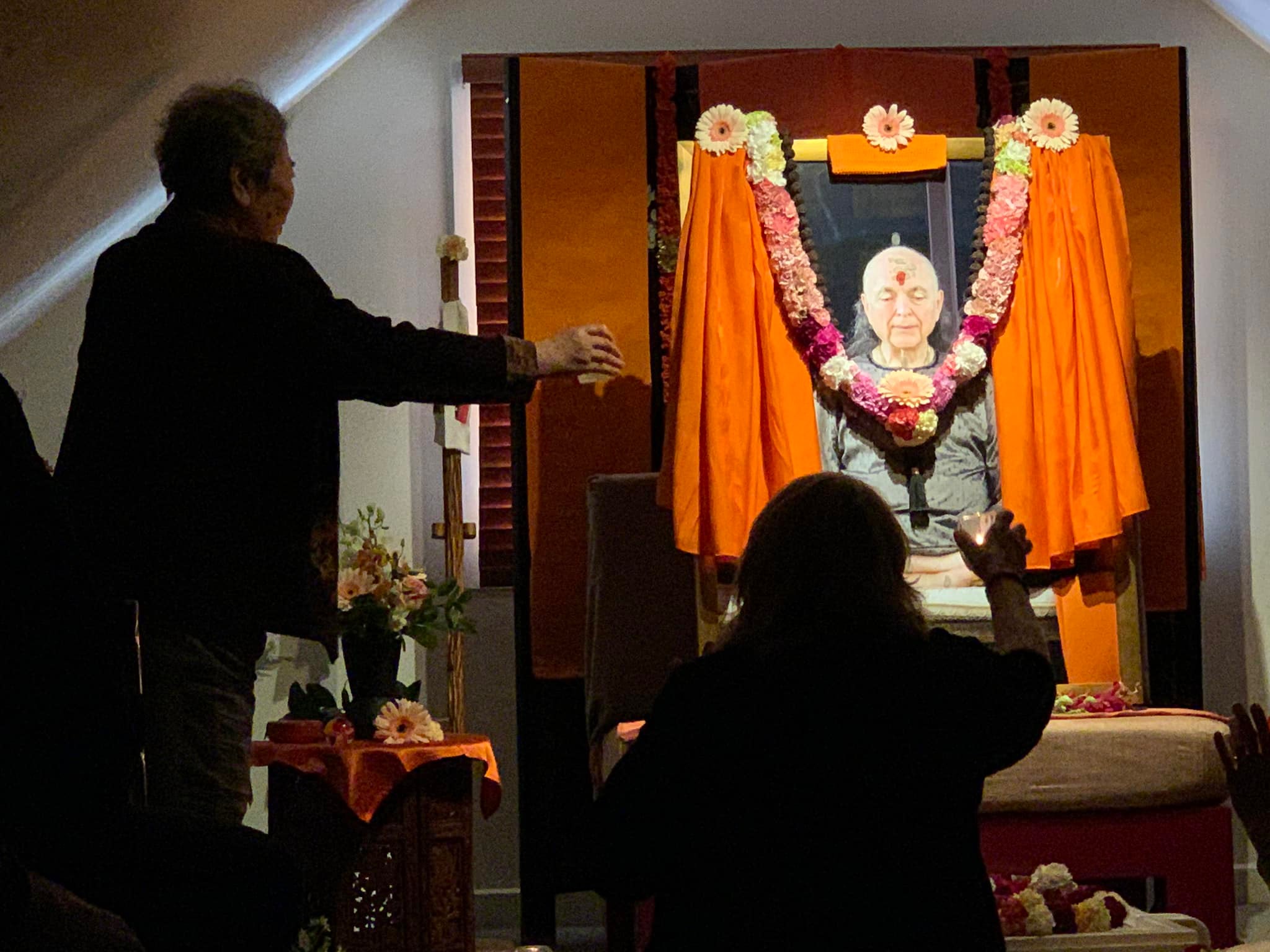 a Murti photo in use in a devotee Communion Hall |
"She" painting auction site — The birth of a new spiritual tradition like Adidam entails countless expenses. Hence fundraising among devotees has been an ongoing process from the start of Adidam. As Adi Da put it in 1974:
You are not in heaven. This is the Earth. Everything here costs life, effort, and money. It costs a great deal of life, effort, and money to function as a gathering of religious or Spiritual practitioners. The purposes of such a gathering may be religious or Spiritual, but a living culture must fulfill the same functional laws as any household or any business corporation.
Some of the financial needs were local and regional, while others were global. As devotees, we were always in resonance with whatever the fundraising need might be, and we gave as fully as we could to all the many worthy causes. Adi Da developed a truly wonderful way for devotees around the world to do this. He called it a "Pazooza Puja". "Puja" was the Hindu word for a sacred ritual. And of course, "pazooza" was a slang word for currency. (As best as I can determine, it dates back to the classic, 1938 Disney short, The Brave Little Tailor, starring Mickey Mouse.) Pazooza Pujas were high-energy, delightful events involving the worldwide community of devotees, usually occurring in real time, in which items were auctioned off to devotees around the world who were bidding for them, led by a high-energy devotee auctioneer. Often, the items up for bidding were personal items that Adi Da Himself had donated — an item of clothing, a statue that had been sitting on one of His shelves, etc. — and that would be especially precious to any devotee who won it.
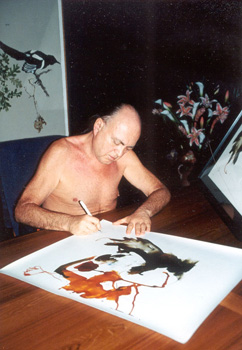 Adi Da signing one of His "She" paintings for the Pazooza Puja |
These days, devotees have access to Adi Da's Darshan primarily through videos that were taken of a live Darshan occasion. But there was a period during Adi Da's lifetime (which many longtime devotees can still recall) when these Darshan occasions were being broadcast live in real time across the Web.
And, even before video live streaming was possible, there was also one occasion of "live" Internet Darshan. I've put quotes around "live" — you'll see why in just a moment.
In early 1996, I was with Adi Da at Da Love-Ananda Mahal, the Adidam Sanctuary on the island of Kauai in Hawaii. He told me He was going to have a Darshan occasion on the lawn of the Sanctuary. Then He asked me if there was any way that the occasion could be captured (in as close to "real time" as possible) for the worldwide sangha, via the Web. So I told Him how we could do it with the means available to us at the time, to which He replied "Tcha" — and so we did it!
The conch blew.[3] Adi Da strode across the grass, and sat on the specially prepared wooden seat at Grace Leans, on the front lawn of Da Love-Ananda Mahal. He looked extraordinary, my heart instantly recognizing Him as the Divine in Person. I was standing there with my digital camera in hand, and as soon as He had settled on His seat, I snapped this picture:

And then I ran like a crazy man for about a third of a mile, to a little hut in another corner of the Sanctuary, where a computer was set up, awaiting me. As quickly as I could, I uploaded the image I had just taken onto the Web, at the pre-arranged location on the Web where everyone around the world was waiting to see it. Then, grabbing my camera, I raced back again across the green lawn, until I stood directly in front of Beloved Adi Da again (and behind everyone else sitting there), and snapped another picture. And then I was off again! Racing for dear life across that lawn, to upload another picture.
All in all, I managed to upload three pictures before the occasion was over, and it took me quite a while to fully recover my breath from all that running. As I look back, I am laughing heartily — it truly was a hilarious situation! But none of the devotees sitting on the lawn in front of Adi Da at the Darshan occasion saw me. I was standing behind all of them when I was taking my pictures. The only people who were aware of the hilarity behind the scenes were me and Beloved Adi Da. He was looking straight at me, each time I took a picture, giving His Regard to the devotees around the world who would see His picture a few minutes later.
Later He let me know He was very pleased with this first "live" Internet Darshan. Indeed, He was so delighted in that moment with the capabilities of the Internet, that, later that night, He engaged in His first chat with devotees around the world. His Presence online was unannounced, and the name under which He appeared was not one that would give away Who was actually on the chat. He enjoyed that circumstance immensely, as you can see (below) in the picture of that occasion. (I'm sitting directly in front of Him and the laptop.)
The next time we had a live Internet Darshan it was using video-streaming, and was actually "real time" — so no devotee had to run like crazy, ever again, to simulate "real time" Darshan!
FOOTNOTES
| [1] | I also had help in finding places to host the website. There were no commercial "web hosting" companies in existence yet; they would only arrive in 1995. If you wanted to launch a website before 1995, you had to have access to a privately hosted server (at a major university, a Web-related corporation, etc.) In early 1994, when I left Rutgers University for a few months stay at the pioneering Internet/Web company, O'Reilly & Associates (now known as O'Reilly Media), they generously let me host the nascent Adidam site on their Web server. And when I moved to the Mountain Of Attention in late 1994, Adidam supporter and software engineer Jon Twigge generously provided a temporary hosting home (in the United Kingdom) for the site, until commercial web hosting companies came into existence the following year. The site didn't have its own domain name (e.g., freedaism.org) at the time, because the ability to purchase a domain name would only come into being in 1995. | [2] |
Adi Da has (briefly) described the "tiny organisms" that transfer "consciousness" between the various "bodies" or "functional sheaths" in His autobiography, The Knee Of Listening: . . . now all of these things — the forms, the levels of functional being and conditional identity (including the physical body, and even all the functional sheaths, and all the conditional realms, and all conditional experiences) — stood within the Radiant Sphere of my own Presence, and I understood and inherently (and Divinely) Self-Recognized them all, without recourse to them (as if they were "outside" my own Self-Nature), and without recourse to any sense of self-separateness (as a limited subjective identity in apparent relationship to them) . . . I was able to see subtle mechanisms within these bodies (or functional sheaths) and perceive the relations of various forms and currents of energy beyond the physical. I saw the tiny organisms by which energy and conditional awareness are transferred and communicated between the various levels of existence. |
| [3] | The conch shell has been used in sacred Hindu ceremonies since ancient times. The sound of the conch is loud (carrying across great distances) and primal, and traditionally has been understood to be the sound of the Divine, purifying the environment and dispelling negative energies. In Adidam, the conch was blown whenever the Guru was approaching, to enable all nearby devotees to prepare to greet Him. | |
| [4] | There was no separate Dawn Horse Press website at the time, of course. | |
| [5] | This line of books continues to be of such high quality and so comprehensive that it appears that the books were used (illegally, without permission) by OpenAI to train the current version of ChatGPT, according to a recent study. | |
| [6] | As I described in the Introduction to this book, in order to facilitate a Divine Incarnation, great Spiritual Masters had spent thousands of years preparing a unique body-mind vehicle of sufficiently high frequency that it was capable of reaching the Divine. That vehicle was Swami Vivikenanda. When Swami Vivekananda died on July 4, 1902, his body-mind became completely available to the Divine. The Divine, in turn, was instantly aware of this vehicle, and instantly chose to incarnate in the conditional universe through that vehicle, out of love for all beings. At first, this Incarnation appeared in the very highest dimensions of conditional existence (from 1902-1939). But then, based on considerations like how globally interconnected the world had become, the Incarnation chose to be born on Earth in 1939. Because Swami Vivekananda was the vehicle, the Incarnation took place on Earth, because of his karmic association with the Earth. |