 Finding
Adi Da > Chris Tong > Part III (Serving the Adidam Mission) > Chapter 6
Finding
Adi Da > Chris Tong > Part III (Serving the Adidam Mission) > Chapter 6
6. The Next Stage of Human Civilization:
The Reclaiming of Truth and Power from Science by Spirituality
Something new must emerge. That something new is not going to emerge from the pattern of nation-states, or even from the gathering of nation-states (in the form of the United Nations). That something new can only emerge from everybody-all-at-once — the power of humankind as a totality.
Music for a civilizational inversion:
All the languages of the world speaking "Something new must emerge",
set to The Beatles, A Day in the Life. (More in an earlier chapter.)
I have mentioned how, in the current "Kali Yuga" civilization, in which materialism is on top, the message of Adidam is considered "taboo". To reach large numbers of people, we have to take them through a profound re-education process, that allows them to see and appreciate how what they thought was taboo is, in fact, an extraordinary Offering and Opportunity.
I also have mentioned how the same conversion in people can occur if we make more widely available experiential evidence of the Reality of the Adidam Offering, through (among other things) more devotees functioning as Instrumentality (in ways that are tangible to non-devotees) and greater incidence of miracles based on Divine Power.
I now want to consider a third alternative: one where the civilization around us undergoes a radical "inversion" — where what was on the bottom rises to the top, and what was in ascendency (materialism) loses its value. It is just such a civilizational inversion that can make true the spiritual vision I had of time-travelling into the future and discovering that the entire world now acknowledged Adi Da's Offering in a big way.
So in this chapter, I'll first take a brief look back at the stages human civilization has gone through thus far, and how they suggest the time is now ripe for just such a civilizational inversion. I'll then explore how past history and current trends ("the spirituality movement") suggest the form the next stage of human civilization will take: a civilization in which science and spirituality share responsibility for revealing truth, and for innovating technologies (science-based, spiritual, and a combination of the two) that help bring us into greater alignment with Reality Itself, and which (secondarily) give us more power over conditional existence, both material and greater-than-material. I'll conclude PART III by exploring how Adidam can play a leading role in the development of this new civilization. Such a role would naturally transform the world's view of Adidam in very positive ways, helping it become something that is both highly respected and highly attractive.
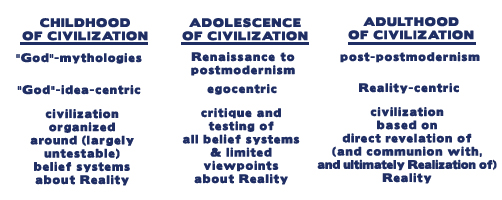
In order to understand Adidam's potential role in the next stage of human civilization, we need to understand the stages of human development to date. While it is not possible to do that subject full justice in the span of a single book chapter, we can provide a brief overview by focusing on Western civilization, and on how the notions of truth and power have evolved. In using the word, "truth", I will not be meaning "Truth" with a capital "T", as Adi Da uses the word (in an ultimate sense, to mean "That which is always already the case"). I will mean "truth" with a little "t": knowledge about what is true of conditional existence, and what means people use to find such "truth" and determine what is "true". And by "power", I'll mean "power over conditional existence". I'll be specifically focusing on how people find ways to sufficiently control their circumstances so as to lead the highest quality of life. And I'll especially be focusing on the development of the incredible "1-2 punch" of science conjoined with technology, where science, as it has evolved in the last half a millenium, has been incredibly effective at discovering truths about conditional existence; and technology has taken those scientific discoveries and has created technological innovations that have given human beings tremendous power over conditional existence, and have greatly enhanced the qualitity of our lives.
So let's jump back in time to Europe in the Middle Ages, which lasted about a millenium, from about 500 to 1500 AD. Sociopolitically, the dominant unit was the manor — a large, agricultural estate owned by a feudal lord: "the lord of the manor", who came into his position of nobility by heredity, and was served by serfs who, also by heredity, were bound to their particular lord for life and who lived on (and subsisted off of) the manor's land. (If the manor were ever sold, the serfs would be transferred with it, as they were considered part of the land.) Serfs were the largest social group, making up anywhere from 80% to 95% of the population, according to various estimates.
Re: power — Serfs worked the land owned by a lord in exchange for protection and a place to live. That arrangement was the core of their existence. Leaving their lord generally meant abandoning their livelihood and their only security, so few serfs did. In general, they completely relied upon their lord to protect them and provide at least the basics of human existence, and they had little motivation (or means) to learn new or better ways for gaining more power over their circumstances. Towns were just beginning to come into existence, but agriculture-oriented serfs lacked the urban skills that would have enabled a transition from manor to town. Relatively little technological development occurred during the Middle Ages, because the primary driver of development — science/technology — did not exist yet. The suite of available agricultural tools (oxen-drawn plows, scythes, sickles, hoes, etc.) pretty much remained the same throughout the Middle Ages, with only a few innovations: the crop rotation system by the 9th century, the heavy plow between the 8th and the 12th centuries, the horse collar in the 12th century. Technological dissemination also was slow: it took four centuries for everyone to be using a heavy plow! Compare that to the speed of disseminating the latest iPhone.
Re: truth — People in the Middle Ages had none of the sources of knowledge we do today. Most were illiterate. (Literacy was concentrated in the clergy and the nobility.) This time period was largely before the invention of the printing press (in 1440), so most books were locked away in the monasteries. Most knowledge was transmitted by word of mouth. People learned their Christian belief system from basic religious education by the local parish priest. There was little questioning of these beliefs, both because the belief system itself discouraged it (with the fear of hell, etc.) and so did the Church (e.g., the Inquisition). The last thing you wanted to happen was for someone to go accusing you of "heresy"!
In a real sense, the time period of the Middle Ages could be said to be the childhood of civilization, because the majority of the population were locked permanently into positions of dependence on both secular authorities (the feudal lords) and religious authorities (the clergy), and had little to no motivation to question authorities, engage independent thinking, or step out on their own: for a serf, there was basically only one acceptable way of living and only one acceptable belief system.
The next stage of human civilization — which we will call the adolescence of civilization — started with the Reformation (starting in 1517) and the Renaissance (from 1450 to 1650), and, in some sense, continues to the present day. A number of key milestones stand out:
- The printing press. In Germany around 1440, Johannes Gutenberg invented the movable-type printing press, enabling the mass dissemination of knowledge for the first time. The printing press was far more than a technological innovation. It created a cultural revolution in encouraging large numbers of people to learn how to read (a skill previously limited to the clergy and nobility) because of the availability of relatively cheap books. This allowed large numbers of people access to alternative viewpoints for the first time. And that initiated the migration of control of truth and power out of the exclusive hands of the Church and the nobility, where it had been concentrated. Use of the printing press turned out to be the single most important factor in the success of the Protestant Reformation, as we will see in a moment.
- Protestant Reformation. On October 31, 1517, Martin Luther, a professor of moral theology at the University of Wittenberg (in Germany) posted his 95 Theses ("Disputation on the Power and Efficacy of Indulgences") on the door of All Saints Church in Wittenberg, and started a revolution by so doing. For some time, the Catholic Church had been allowing a practice whereby clergy could sell "indulgences" to ordinary people. The indulgences were supposed to lessen the amount of time a person had to spend in Purgatory, after they died. You could buy an indulgence certificate for yourself or for a recently deceased loved one. The Catholic Church, particularly the pope, was the primary beneficiary of indulgence sales. A popular pushback that viewed the practice as corruption had been growing, but it was Luther's 95 Theses that encouraged the murmuring to swell into a full-scale rebellion that swiftly spread across the entirety of Europe. The invention of the printing press played a critical role. The first major work to be mass distributed by Gutenberg's press was the "Gutenberg Bible". When the Church saw how much money could be made by mass distribution of the Bible, it decided to use the press to print indulgences on a mass scale. In so doing, it had the effect of educating everybody about the matter of indulgences, so that when Martin Luther lit the match (with his own mass printing of the 95 Theses), the result was explosive. As a major part of the Protestant Reformation, Luther also used the press to rapidly disseminate religious materials in the vernacular (i.e., in people's native languages, rather than in Latin) in defiance of Church practice. During the Reformation period that followed, Christianity splintered into a number of new "Protestant" branches (including Lutheranism, Calvinism, Anglicanism, Anabaptism, and Methodism), based on the panoply of variations of Christianity being put forward at the time. Numerous wars were fought ("the European Wars of Religion") over the next century because of the fierce disagreements among the sects (and the Catholic Church), causing widespread death, destruction, and displacement. first major milestone reflecting adolescence.
- Science. The success of science via technology.
- Technology. The success of technology. The Industrial Revolution.
- Empirical evidence valued over dogma.
- Science on the rise, religion in decline.
- Questioning of authority and egocentrism.
- Science is objective; religions are purely subjective.
Human civilization is now in a transition period. Science — coupled with technology — has had an incredibly successful run over the last few centuries. It poses scientific theories, tests and confirms those theories in the lab or in the field, and then goes back and adjusts, refines, and improves the theories based on what has been found. Even as the theories become ever more comprehensive and accurate, practical new technologies are constantly being developed, based on the current scientific theories — and these technologies have completely transformed our lives. What is more, the successes of science and technology are additive; they keep building on each other, causing the number of innovations, and the rate at which beneficial change is occurring, to increase exponentially with time.
In contrast, traditional religion has no comparable mechanism for improving itself or producing tangible results comparable to the technologies associated with science. Its dogma or belief system is its “theory", which has remained largely unchanged for millennia (and is largely unchangeable, since it is believed to have been given by God, and God is not in the habit of making updates). It claims that belief results in improved human lives and improved after-life outcomes, through the grace of God, but there is little in the way of evidence to back this up.
So at this point in the history of our civilization, the combination of science and technology is the clear winner in terms of “objective truth”, compared to traditional religion. It produces an endless stream of beneficial, technological innovations that demonstrate that it has a very solid handle on both objective truth and how to use that truth to gain power over the conditional universe. In a real sense, science/technology is the religion of contemporary society. Virtually everyone "believes in" this religion by virtue of making heavy use of all its technological fruits, from mobile phones, to televisions, to air conditioners, and cars. And they "worship" these technologies in the sense that the technologies gather up all our energy and excitement: "Have you tried the latest version of ChatGPT? Wow!"
As for traditional religion. . . it has lost a lot of ground and its influence has been greatly diminished (when compared to the central role the church played in people’s lives in the Middle Ages). Even so, traditional religion has not disappeared altogether. It still “hangs in there”, largely because the questions it claims to have answers for — the meaning of life, is there a God, what is the relationship of God to us and the universe, what happens to us after death, what can we do to improve our after-death outcomes, etc. — are central to human life and existence, but have not been addressed by science and technology. And, while some would like to believe otherwise, some of those questions may never be addressable by science and technology, because they fall outside the scope of what science and technology are capable of understanding.
In this transition period of human civilization, the connection between religion and truth has become very fuzzy. It's considered "spiritually correct" to say things like "All religions are paths to God". But to make any general statements about what a religion is capable or incapable of realizing is frowned upon. The only acceptable statements are ones that avoid getting specific, like "religion is a personal matter" and "you can't tell anyone what they can or cannot realize spiritually through their chosen religion". Such "spiritual correctness" can be understood, in part, as a counter to the long history of religious intolerance, often leading to religious wars. Consider the Crusades, which took place in the Middle Ages. The Crusades pitted the Christians, who viewed themselves as the followers of the "one true faith", against the Muslims, who believed all non-Muslims were "infidels". And both sides were fighting over a "holy land" they each claimed, on the grounds of religious history. And such religious conflicts are not just ancient history; they continue into the current moment: the Israeli-Palestinian conflict, the Hindu-Muslim conflict (particularly in Kashmir), etc. So, on the one hand, we do want to move beyond such religious intolerance and its horrific consequences (including war).
But "spiritual correctness" has another side, that is more the product of the enormous success of science and technology. This side of "spiritual correctness" recalls that, unlike science and its basis for truth in evidence, religion has always simply pronounced its dogma as truth, and often imposed that view by force (e.g., the Inquisition). That track record, combined with the fact that there has been little to no scientific investigation into the truth of all the religious dogmas, suggests to many that religious dogma simply is not testable, and that is the actual subtext underlying objections against making comments about the truth or falsity of anyone's beliefs. And that has the side effect of essentially giving all the credibility and power associated with "objective truth" to science and technology, and robbing it from religion. Unlike when Apple releases the next iPhone model, there is no vast group of Catholics eagerly awaiting the next breakthrough in religious technology to be released from the Catholic Church!
In describing the current period of transition, I've been largely contrasting science/technology and religion, noting the rise of the former, and the diminishment of the former. So where does "spirituality" fit into this picture?
"Spirituality" means different things to different people, depending on what they are seeking (e.g., something that is demonstrably real) or what they are running away from (e.g., corrupt organizations). And it's useful for those in the Adidam Mission to be familiar with all these senses of "spirituality", since by far the greatest number if people interested in Adidam are spiritual seekers. Here are some of the people attracted to spirituality, along with their motivations:
- A contrast with organized religion. The summary portrait I've just painted of the respective roles of science/technology and traditional religion in current human civilization accounts for why there have been a growing number of people leaving organized religion and drifting towards “spirituality” of one kind or another. Many polls reflect this shift. For example, a 2023 Pew Research study[1] found that 7 out of 10 Americans describe themselves as spiritual in some way, and many of these individuals are distancing themselves from organized religion. Such spiritual seekers are looking for answers to the core questions about meaning, existence, and happiness we all share. They are dissatisfied with traditional religion’s inability to confirm its claims in an evidence based manner like science; and they are dissatisfied with there being no comparable “religious technology” for making practical use in our daily lives of all traditional religion’s claims. But they also are dissatisfied with science’s and technology’s lack of satisfactory address to these core questions. So they hope to find or piece together on their own some form of spirituality that will “do the job”. You can engage spirituality without being associated with an organization and all the limitations that can accompany that (corruption, restrictions on what you can do and what you can believe, etc.)
- self-empowerment. You can decide for yourself what you are going to believe, what practices and rituals you will engage, etc.
- Empiricism and evidence-based exploration. You can focus on spiritual experience and exploration (rather than just belief), and draw your own conclusions about the nature of reality (and create your own personal meanings) based on your own empirical data.
- Science and Spirituality: control of truth and knowledge about power over nature is almost entirely in the hands of science and technology. imbalance needing correction. It instead needs to be co-shared by spirituality.
- Who is in charge: another imbalance needing corection. secular and religious powers -> insubordinate egos -> individuals subordinate to Reality Itself
Indeed, we can identify and as yet unnamed cultural movement that includes these defectors from traditional religions (among others) that has this specific purpose: to find a form of spirituality (and associated spiritual technology) that demonstrates the same merits as science and technology relative to objective truth and power over conditional existence.
I'll give this movement a working title: the "Reclaiming of truth and power from science by spirituality" movement, or "Spirituality Movement" for short. Here are just some elements of this “yet to coalesce“ movement. Some elements have been around a long while, while others are relatively recent. We can divide the elements into two basic categories: spiritual science and spiritual technology. Spiritual science is about the study of phenomena typically associated with greater-than material dimensions. Spiritual technology is the practical use of spiritual phenomena, practices, ideas, or principles.
The Spirituality Movement includes the following elements of spiritual science (among others):
- Neurotheology. For many years now, the Dalai Lama has worked with neuroscientists to organize brain scans of Tibetan Buddhist monks, with the intent of seeing if there was an “objective correlative” (in what was being displayed in the brain scans) at the same moment the monks themselves would report something significant going on subjectively (e.g., entering a deeper meditative state).
Working from the other direction — starting with neuroscience and looking to make a connection with spirituality — a number of scientists have started a field called “neurotheology”, which investigates correlations between brain function and spiritual or religious states. One of the most notable researchers is Dr. Andrew Newberg, who has conducted brain scans on praying nuns, meditating Buddhists, and chanting Sikhs, comparing their brain activity during these practices with their brains in a state of rest. Here is just one of the things he has discovered. Many forms of meditation begin with practices the activate the parasympathetic nervous system (e.g., clearing one's mind of thought and withdrawing from sensory stimulation). As the meditation deepens, the subjective sensation of a relaxation grows to a profound quiescence. As elements of the parasympathetic nervous system become fully aroused they "spill over" into and activate the sympathetic nervous system. When both the sympathetic and parasympathetic portions of the autonomic nervous system are maximally aroused, one experiences a mystical state.[2][3] - Occult/paranormal phenomena. Ghost sightings have been around forever. But starting in the nineteenth century, mediums, seances, talking boards (the precursor to ouija boards), etc. were attempts to find more tangible ways to confirm the presence of deceased spirits. This has continued to the present day, with more sophisticated paranormal technology (EMF meters, etc.) now available. These can all be viewed as elements of an evolving effort to create a science of paranormal studies. A sign of this was the creation of the Society for Psychical Research in 1882, whose purpose was to collect evidence for the paranormal and convince the scientific community.
- Near-death studies.
- Reincarnation studies.
The Spirituality Movement includes the following elements of spiritual technology (among others):
- Miracles. The manifestation of miracles has been one of the few areas of religion where there could be a claim of objectivity for a spiritual phenomenon: miracles that are witnessed by others, which is what endows it with objectivity. In Western civilization, The miracles of Jesus were the start of this tradition of "miracle workers" in the West, with the miracles he performed being recorded in the New Testament. The Christian saints then continued this tradition down through the centuries. Indeed, the Church created the principle that a person could not be officially designated a saint by the Church without being able to make a case for their having been responsible for at least one miracle. Added to this tradition is the association of places with miracles, such as Lourdes with the healing of the sick (attested to by the large number of crutches hanging on the wall of the grotto where Mary appeared to Bernadette, left there by people who entered as cripples, and left walking). We see analogues in other religious traditions, such as Hinduism, where healing the sick or the ability to materialize vibhuti (sacred ash) are examples of the kind of miracle people would look for to confirm saintliness.
- The law of attraction. These days, there are many books and seminars devoted to “The Law of Attraction”, a “spiritual technology” that is based on the view that positive or negative thoughts and feelings attract corresponding experiences and circumstances into one's life.
- Mindfulness meditation. Forms of mindfulness meditation (borrowed originally from Buddhism) have now become popular in every corner of society, from businesses, to elementary schools, to sports training.
The Spirituality Movement includes the following organizations devoted (completely or in part) to the study of spiritual phenomena and the study and development of technology based on spiritual phenomena. Here is a partial list of such organizations:
- The Institute of Noetic Sciences (IONS) — This research center focuses on the intersection of science and human experience, investigating phenomena that challenge mainstream scientific paradigms regarding the nature of consciousness. Researchers associated with IONS include Dean Radin and Rupert Sheldrake.
- The Division of Perceptual Studies (DOPS) — carries on the work of Dr. Ian Stevenson, who founded it in 1967. Located at the University of Virginia, this research group investigates extraordinary human experiences and capacities, focusing on the mind's relationship to the body, the possibility of consciousness surviving physical death, and reincarnation studies.
- The International Association for Near-Death Studies (IANDS) — IANDS focuses on near-death experience (NDE) research and supports individuals who have experienced NDE's.
- Koestler Parapsychology Unit — Located at the University of Edinburgh, this unit conducts parapsychological research.
- The Academy for the Advancement of Postmaterialist Sciences
- Centre for Research on Consciousness and Anomalous Psychology (CERCAP) — located at Lund University, Sweden
- Essentia Foundation
- American Center for the Integration of Spiritually Transformative Experiences (ACISTE)
- Mind & Life Institute
- Society for Consciousness Studies (SCS)
- Society for Scientific Exploration (SSE)
- National University Master of Arts Program in Consciousness and Transformative Studies — This program focuses on exploring consciousness, personal growth, and societal transformation through an interdisciplinary approach. It integrates philosophy, psychology, religious studies, and newer sciences like neuroscience and quantum physics. The program also emphasizes applying consciousness principles and engaging in transformative practices.
Remember the story of my graduate student, Nathan? Let's review again what he said after being blown away by an Invocation of Adi Da, because it is very relevant to our current topic:
As soon as you started the Invocation, I felt a huge power above me and all around me. It felt like a gigantic force field! It enveloped my body and I could feel all kinds of sensations throughout my body, like energy flows. And — I can’t explain why I felt this — but it felt like there was a Being associated with all that force and energy and the Being was drawing me into Itself and it felt wonderful!
I have to tell you: I feel overwhelmed by this experience, which is like nothing I have ever experienced! And it changes my feeling about the nature of reality. I guess I had been expecting something like a usual religious prayer, where they call on God, and you’re supposed to feel something as a result of "God", but of course it's really just you yourself generating a feeling inside, in response to the suggestion of the prayer — you know, a little peace, or love for others, or whatever the prayer is suggesting. But this is completely different — it's real! It isn't something I'm generating myself. That huge force very definitely came from outside me, without a doubt! It was objective, as real as the floor and as real as you guys. And that's what is blowing me away! Until this very moment, I've always thought of religion and spirituality as basically something associated with a person's internal subjectivity. There could be beliefs about God and Heaven, but basically it was the individual making themselves feel good. To know, as I do now, that there really is something — Someone — that is Real and non-material, and can be felt as a huge, invisible Presence, is completely mind-blowing.
Nathan's point is representative of the larger, materialistic culture. Most everyone believes religion and spirituality are largely subjective, an individual's inner experience, not replicatable or provable to anyone else. If we can demonstrate otherwise — e.g., by confirming that 80% of the participants in one of our events were able to say they felt a "Presence" in the room, it would transform the Mission, and set Adidam apart from all the other spiritual offerings out there by offering demonstrably objective offerings to the public.
C.P. Snow wrote a famous book, The Two Cultures about science and the humanities, but could equally apply to science and religion. It captures something of the respective roles science and spirituality are playing the current transition period in human civilization. But in the next stage of human civilization, these two currently distinct (sometimes even antagonistic) cultures will work together. Spirituality and science will be partners in being responsible truth and power. There will be many hybrid innovations using both spiritual and scientific technologies.
There will be no conflict between religion and science in the new and future culture of Man. Religion will not be irredeemably distorted by the illusions of "subjectivity", and science will not be irredeemably distorted by the illusions of "objectivity".
The power of the technology is generally taken as a corroboration of the truth of the theory (whether the theory is a scientific theory, or a spiritual belief system). This is the case with modern technology and science. But it was also the case with Jesus's ability to perform miracles, which was taken as corroboration of the picture he painted of the nature of reality.
Once we start moving into the next stage of human civilization, and spirituality (possibly with the help of Adidam devotees) starts reclaiming from science a real foothold on truth and power, many of the incredible challenges the Adidam Mission is currently facing will dissolve or lose much of their force. Adidam will not only no longer be viewed as "taboo", but even has the possibility of playing a leadership role in the development of this next stage of human civilization, with ongoing contributions that could be eagerly awaited by many.
Here are several ways, for starters:
- Expand the Institute for Real God to be a research institute (like The Institute for Noetic Sciences) as well as a place of learning as described in
the last chapter — in other words, creating a synergistic circumstance much like modern universities. There are endless studies we can initiate
that have not even been conceived by anyone else because they are based on ideas unique to Adidam. Here is just one such study that Adi Da mentions in passing:
At the level of touch we read the very condition of the nervous system in space. But, as touch, that condition is blind, it is prior to the usual body sense, prior to all the intellectually organized complexity of inwardness. Inwardness vanishes, and what is seen is at the skin level. Our contraction from infinity can possibly even be measured in terms of electrical activity at the skin level. It is only when the sense of touch becomes Enlightened that the subtle activity at the level of the skin achieves the Native State and permits bodily intercourse with the Infinite Radiance.
"Our contraction from infinity can possibly even be measured in terms of electrical activity at the skin level": a perfect description of an investigation that the (expanded) Institute for Real God can conduct! — one that is unique to Adidam, because it is based on Adi Da's concept of the self-contraction. And once we start conceiving of the elements of our practice of the Way of Adidam in such terms, we can easily imagine developments that mirror technological development in other fields. For example, once you have a tool for measuring and quantifying a person's self-contraction, you could develop an accompanying biofeedback technology that will allow us to "learn" how to contract less, in the same way other biofeedback technologies work. Such a technology could be of great help in the listening/hearing process, since Adi Da calls us to feel to, through, and beyond the self-contraction from the very start of the listening/hearing process, long before we have located the self-contraction itself. (See quote below.) And this technology could reflect how well we are doing that.
Feel into that knot of stress. Feel into it and account for it. See it as your own action. Regard Me in that moment, in every moment. And then you begin to feel Me. Then the surrender comes, the self-forgetting comes, the native sense of Non-Separateness is felt. This is actually what I am Calling you to do! Actually to do that. Just to be doing it grants equanimity to you, even bodily, grants equanimity to your speech, your actions, your feelings, because you are registering this depth-point and going beyond it and feeling Me. This is the context of practice of the Way of Adidam, not merely outer observances. This is what it means to listen to Me: to be examining this point of contraction in depth, to feel it, and by its unfolding to feel Me. This is not the end of the Way of Adidam. It is the foundation of it. Self-understanding and devotion at depth this is what you must do in every moment. This is what it is to practice the Way of Adidam.
Another example: In an earlier chapter, I told the story of Rachel, who had a special psychic ability: she could see people's "psychic forms". The story went on to describe how she watched "me" vanish one morning, in meditation. So what she was watching was my self-contraction spontaneously relaxing in Adi Da's Divine State. The fact that she had such an ability suggests the possibility that a form of technological imaging (analogous to CT scans, brain scans, etc.) could be developed that was capable of doing what Rachel did: it could image the "ego" when the self-contraction was active; and video its disappearance, when it was released. Such a technology would be a strong confirmation of the power of the Way of Adidam to literally dissolve the self-contraction — something that would very likely stand out as unique, if the same technology were applied to practitioners of other spiritual traditions.[6]
- While the unofficial "spirituality" movement is feeling its way toward restoring truth and power to spirituality, there are a lot of areas where it has not yet ventured, and where Adidam can play a role or even lead the way:
- It has not yet done much in the way of confirming God as a real, tangible Presence right here. Of course we know part of the reason for that: God was not accessible in a real, tangible way right here before Adi Da's Incarnation here. But because He has incarnated, and because we have the capability of devotees growing in practice to where they can serve as Instrumentality, we also have the possibility of doing studies on what can be said objectively about that Presence. Invocation occasions can be studied (in a respectful way of course). Researchers can document the experiences of participants. They can get statements like I recorded for Nathan. But it also can be more formal and rigorous, through, say, an extensive questionnaire about what they experienced. (I should note in passing that such a study would be absolutely perfect to conduct at an organization bearing the name, "The Institute for Real God"!)[4]
- Spiritual Realization — The seven stages of life framework. The Basket Of Tolerance.
A Progressive Inversion: The Adulthood of Civilization.
MORE COMING SOON
A Sudden Inversion: Contact With More Advanced Civilizations. If you've been reading this book from the beginning, you'll recall from an earlier chapter that I had a rather dramatic encounter with a UFO — it hovered silently over my head, out in the middle of nowhere, for an entire minute, before it split into three smaller craft and each shot across the sky and out of sight without a sound.

I understand very well the difference between someone who has had such a direct experience of extraterrestrials and someone who has not. It is huge, just like the difference between someone who has had the Revelation that Adi Da is the Divine and someone who has not. Someone who has not had such an experience can entertain the intellectual possibility of extraterrestrials. But such thinking tends to be fairly timid. The US Congressional hearings on Unidentified Anomalous Phenomena (UAP) exemplify that kind of thinking. The participants are all open to the possibility of the existence of extraterrestrials, but the conversation stays at the ground level: can we be sure this video is of an extraterrestrial craft? Or could it be the advanced technology of a competitor nation-state (like China or Russia)? The conversation tends to remain there, when it is among people who have not had any definitive experiences of extraterrestrials.
MORE COMING SOON
FOOTNOTES
| [1] | The 2023-24 Religious Landscape Study (RLS) from the Pew Research Center. | |
| [2] | Eugene d'Aquili M.D. Ph.D. and Andrew B. Newberg M.D., The Mystical Mind (Theology and the Sciences), Fortress Press, August 30, 1999. | |
| [3] | The focus of neurotheology is the finding of correlations between brain phenomena and spiritual phenomena, such as finding that when someone is in a "mystical state" there tend to be certain distinguishing characteristics of the brain scan patterns. A key principle of neurotheology is to not fall into a reductionistic trap (of materialism), by confusing correlation with causation. The trap would be to suggest that the physical brain is causing the mystical states, rather than such states having something to do with an actual spiritual reality. | |
| [4] | An early study that is worth comparing with is William James, The Varieties of Religious Experience. | |
| [5] | Interestingly, we actually can make an analogy between science-based technology and religious technology from the Catholic Church: the Church does occasionally announce "religious technology" advances of very specific kinds. One is when the Church canonizes new saints. In principle, such new saints then become new spiritual resources that all Catholics can draw upon in their prayers. (Catholics don't pray to saints like they do to God. They ask the saints to intercede for them, i.e., to pray to God on their behalf.) Far more rarely, the Church also confirms the sanctity of certain special places (usually where miracles are believed to have occurred), like the Grotto of Lourdes, where Mary is said to have appeared to Bernadette. Such places also serve as "religious technology" in that Catholics can then visit them on pilgrimages, to draw upon their spiritual power. And there can be real spiritual power in such places! One of my friends who had breast cancer visited Lourdes, and her breast cancer went into complete remission after the visit. | |
| [6] | I don't think any such technology is likely to be implementable any time soon. But I am writing this book with the thought that it may have some readers even centuries from now, and those readers may be able to careate technologies we can only barely conceive of at the present time. | |