Finding
Adi Da > Chris Tong > Part I
(Finding the Divine in Person) > Chapter 4
Finding
Adi Da > Chris Tong > Part I
(Finding the Divine in Person) > Chapter 4
4. A Crisis of Faith and a Place To Grow
|
|
| This is Part I, Chapter 4 of Chris Tong's book, Finding the Divine In Person and Waking Up From the Dream. | |
|
|
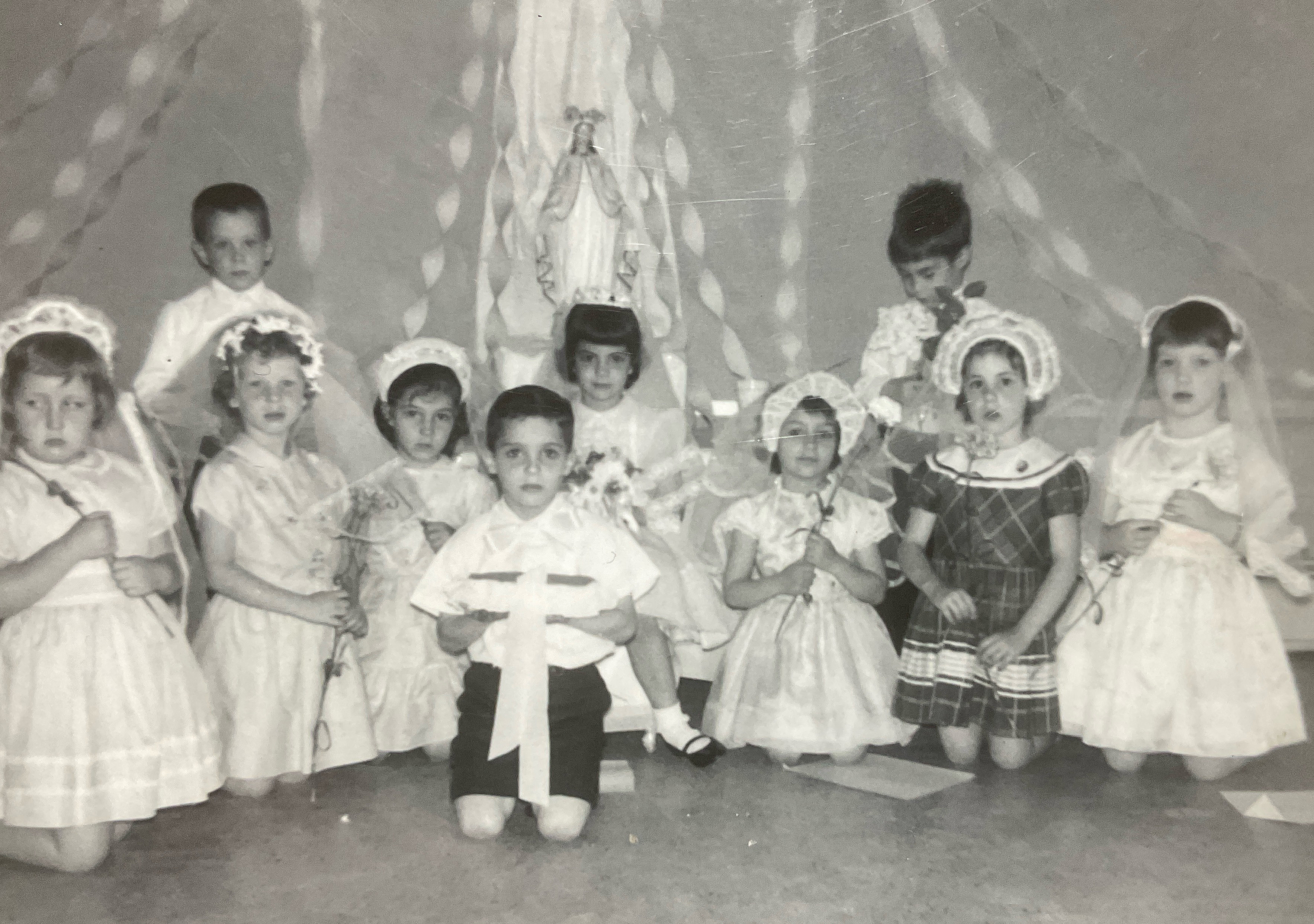 Chris (upper right) during a religious celebration at his Catholic school (click image to enlarge) |
I would carry that Catholic faith with me until I was a young man, attending Columbia University in 1975 (like my father and mother before me) — and the extensive and rigorous education process there ripped that faith from me, leaving me in a profound crisis of faith.
While at Columbia, I was exposed to a great variety of new influences — the ones considered most influential in shaping "Western civilization" . . . from the ancient Greek writers, to Hobbes, Hegel, Darwin, Marx, and Freud. While a few of these sources (for example, St. Augustine and Dante) were religious, most were materialistic in their philosophy and secular in their focus, and the fact that all of these new viewpoints seemed to have a grain of truth to them shattered my childhood simplicity.
Adi Da's description of His time at Columbia University matched my own experience there perfectly:
 The
experience of study at Columbia was completely devastating.
I had never in my life encountered any kind of sophisticated
thought. But now I suddenly became aware of the literature
of the world. The mood at Columbia in those years was profoundly
solemn and critical. . . . Grayson Kirk, who was then president
of the University, introduced us to college life with a
serious speech about the rising problems of humanity. He
promised that Columbia would not teach us the answers, but
we would perhaps learn the questions. Altogether, he indicated
that Columbia would not make us Happy, but he promised that
we would learn how to think.
The
experience of study at Columbia was completely devastating.
I had never in my life encountered any kind of sophisticated
thought. But now I suddenly became aware of the literature
of the world. The mood at Columbia in those years was profoundly
solemn and critical. . . . Grayson Kirk, who was then president
of the University, introduced us to college life with a
serious speech about the rising problems of humanity. He
promised that Columbia would not teach us the answers, but
we would perhaps learn the questions. Altogether, he indicated
that Columbia would not make us Happy, but he promised that
we would learn how to think.
I was deeply impressed by his attitude, and that of the entire formidable crowd of lecturing "thinkers", talking (and otherwise in attendance) there. Immediately, Columbia seemed like an emininently appropriate, and even ideal, place in which to expand my doubts — but I was puzzled that one of the highest institutions of learning could represent itself as anything but the bearer of Truth. I soon learned that the Truth was always in research in such places. They are not institutions of Truth. They are marketplaces of doubt.
I began to read the deposits of Western culture. And all my idols lost their Power. To begin with, I learned that the "Holy Christian Truth" was anything but the real substance of Western civilization. There is a thesis emphasized in all the little bits of thought generated in a university education. In that thesis, the human being is described as necessarily mortal, functionally conditioned, and (at best) "creative" as a social animal. Also, the universe is described as materially prior to conscious life, and it is chronically understood without recourse to religious or Spiritual propositions... Every book I read and every course I took emphasized this thesis in some unique fashion.
That profound crisis of faith changed the course of my life, and sent me searching in new directions. I ceased being a practicing Catholic, and began instead to value and explore psychology as a means for gaining self-knowledge: my unconscious motivations, the reasons why I was not completely happy, and what I could do about that.
On a practical (and karmic) level, I excelled in my academic studies, following in my parents' footsteps. By now I also had a string of "accomplishments" to add to my resume. In sixth grade, I had placed third in a New England-wide public speaking contest. As a high school junior, I had been awarded a research grant from the state of New Jersey for new research into the origin of life. In 1976, as a sophomore at Columbia, I received the Professor Van Amringe Prize for "best freshman or sophomore mathematics student". As a junior, working during my summer break at IBM's Thomas Watson Research Center, I developed a new algorithm that was considered a breakthrough in the area of system stability.[1] As a senior, I was the narrator of Columbia University's annual Varsity Show, for which I was interviewed by New York City's Channel 5 News — and, for one evening (my "15 minutes of fame"!), I was recognized everywhere I went in Greenwich Village because of a cover story and picture that had appeared in New York City's most read "cultural" newspaper at the time, The Village Voice.[2]
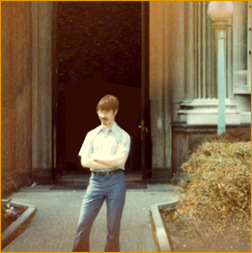
Chris at Columbia University, 1978
In 1978, I graduated from Columbia summa cum laude with a 4.0 grade point average and a degree in computer science.[4] I then moved to California to attend Stanford University for my graduate studies, because it had a reputation for being the best graduate school in the world in the area of computer science.
It all "made sense" on the level of the practical. But on another level, it also was simply another sign of my Guru's presence and influence in my life — a kind of "synchronicity" or "psychophysical resonance", as I (unknowingly) followed in His footsteps: becoming an altar boy at the local church (as He had been); winning an award in a major oratory contest for young people (as He had done); and attending the very same schools He had attended (Columbia for undergraduate studies, then Stanford for graduate studies) eighteen years earlier.
In contrast with the frenetic (and, at times, even harsh) urban life of New York City, I experienced California as a great relief — a place where I could relax psychically, and focus on personal growth. Again, Adi Da's words about His own move from New York City to Palo Alto, California, describe very well what I was feeling, as I began my new life at Stanford University, and in northern California altogether:
 The foothills of Stanford University: "The sunlight was so deeply radiant, the air so soft, and the hills and country all around so dramatic and beautiful" (click image to enlarge) |
Perhaps because the very psyche of the land supports and nurtures it, California has a history of giving birth to new "personal growth" movements and spiritual experiments. And so it was natural that, while I was pursuing my graduate studies in computer science (specializing in Artificial Intelligence), I also made time to explore human and spiritual potential. I participated in an EST-like organization called Lifespring, whose "encounter group" experiences [3] were crafted to spur growth in many areas of human relationship. A great example was an exercise known as the "hot seat". A person would be selected to sit in the "hot seat"; other people in the group would come up and speak, without any self-censoring, whatever came to mind as they looked at the person; and the person in the "hot seat" was required to either stay silent or say "thank you". I remember getting a profound lesson while sitting in that "hot seat", when I was in my early 20's: all the things I was trying to get people to not think about me, turned out to be what most of them were thinking about me anyway! The net result: I relaxed. (As Adi Da humorously puts it: "Relax. Nothing is under control.") From that point on in my life, I let go of a lot of my concern about my "self-image", since, in that moment, I got the point that all that concern was pretty ineffective anyway. The intensity of that group encounter experience (one hundred people telling me what they thought of me!) was what made the lesson both instant and one I would never forget.
Other aspects of the encounter group helped move me beyond the limitations of ordinary psychology into a larger view of reality, that included the possibility of "Enlightenment" as the greatest human potential.
And so I was moved to start reading the literature of Eastern spirituality, and began personally experimenting with the notions I was reading about. I began having energy experiences of various kinds. For the first time, I read about the Guru-devotee relationship in the various spiritual traditions of the world, and began to understand why that relationship has been so valued; and I experienced the tangible spiritual transmission of two Gurus: Jiddu Krishnamurti, while reading one of his books; and the shaktipat guru, Yogi Amrit Desai, as he slowly drove past and looked at me, while I and other retreatants stood on the side of the road (while I was on a brief retreat at his Kripalu retreat center in Massachusetts).
It was all excellent preparation for finding my Guru!
I'll now describe some additional events in my life that helped prepare me for Avatar Adi Da.[5]
FOOTNOTES
|
[1]
|
R. K. Brayton and C. H. Tong, "Stability of dynamical systems: A constructive approach", IEEE Transactions on Circuits and Systems, CAS-26, pp. 224-234, April 1979. The stability algorithms I developed while at IBM have turned out to be widely influential (cited by over 180 other research papers) and have broad applicability, in areas as diverse as biotechnology and the stabilization of greenhouse gases required by the Kyoto Protocol. |
|||
|
[2]
|
|
|||
| [3] | For a comparison of encounter group work with the "Crazy Wise" work of a Spiritual Master like Adi Da, read our article on the subject. | |||
| [4] | I also very seriously considering an alternative career as a songwriter, while being paid by Columbia University to play the piano in the student lounge during lunch time, to provide entertainment. Much more about this in a later chapter. | |||
| [5] |
I'll close out the description of my time at Stanford with another story. In a footnote in Chapter 1, I mentioned how, when I was a baby and my mother was taking me in my baby carriage on a morning stroll down the streets of New York City, we ran into Harry Truman, the former President of the United States. So now I'll add a similar story in a footnote in this chapter. In my first year at Stanford, I ran into the famous physicist, John Wheeler. Or more accurately: he ran into me! I was riding my bike across the major intersection on campus, when a car hit me. It didn't hit me very hard, fortunately — I think the driver had slammed on his brakes — but it did knock my bike over, throwing me to the ground. I immediately got up, no worse for wear, and the driver ran over to me, and asked if I was okay. I said yes. He told me his name was John Wheeler, and gave me his number, in case I needed anything because of that incident. Then he drove away. The name had sounded familiar to me right away, and I soon confirmed with a photo that he was indeed THE John Wheeler. I’ll be remembering him again, in PART II of this book (Adventures with the Devotional Prayer of Changes), when I explore the notion of what I call “wiggle room”: the variety of outcomes still possible in a situation (and therefore still influenceable by the Devotional Prayer of Changes) because the range of possible outcomes represented by a quantum wave function has not yet collapsed to a single outcome. The outcome of even past events still can be influenced by a present-time participant. This was shown by Wheeler in his famous "Delayed Choice Experiment", where he showed that a choice made now by a participating observer could change the past behavior of a photon. This result was part of a much larger view he had, called the "participatory universe", where the universe is literally a reflection of how we are participating in it — which resonates with many current spiritual views, including that of Adidam. 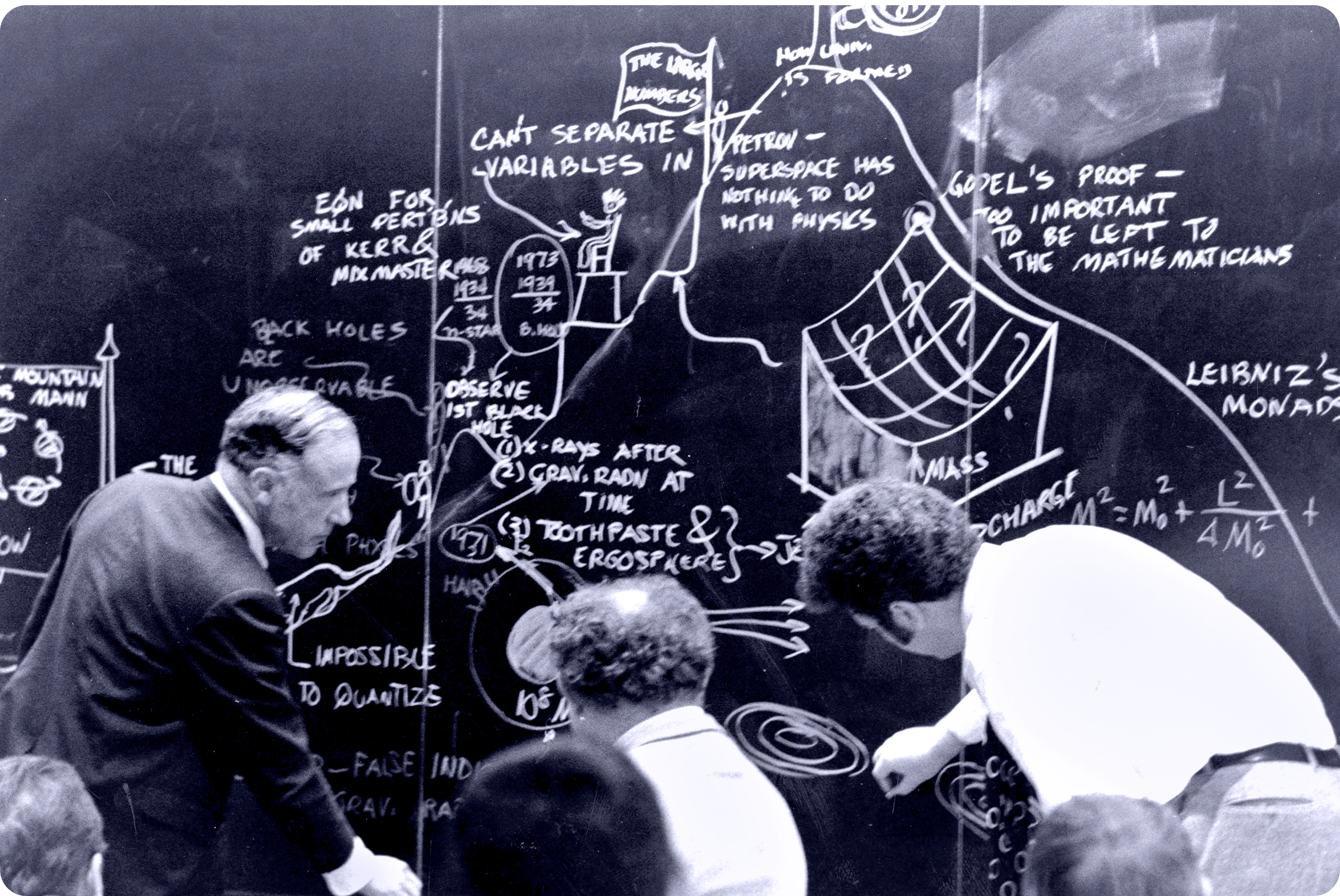 Wheeler (left) and his students working at a blackboard in Princeton in 1970 I made direct use of Wheeler's "Delayed Choice Experiment" result in my Prayers regarding desired outcomes of medical tests. I presumed I had the ability to change the outcome of a test right up to the moment I saw the actual lab results. Even though the test had already occurred, and even though lab technicians had "seen" and recorded the results, most of the time they were doing this with no conscious participation in (i.e., care about or memory of) the numbers they were recording, and they had already forgotten the results by the time they moved on to recording the next lab test's results. It was that very minimal, insignificant degree of conscious participation by the lab technicians that was why the wave function had not yet collapsed by the time I read the results, and I could still influence the outcome. Even the computer records of the results did not imply reality was as recorded on them, because the recording computers were not consciously participating in the event! No fixed, enduring imprint on Consciousness had occurred yet. Now, if one of those lab technicians had taken a personal interest in my results and consciously remembered them, that conscious interest and that conscious memory — that significant degree of conscious participation and investment in the event — would have collapsed the wave function, replacing a range of possibilities with a single actuality, and I no longer would have been able to change it. But in general, lab technicians don't do that. They just do their job and forget specific results, leaving me free to influence the outcome. My take on this resonates with Wheeler's view, "no elementary phenomenon is a real phenomenon until it is an observed phenomenon" — except I'm expanding it to more than just phenomena involving elementary particles. John Wheeler was a brilliant and creative physicist, who singlehandedly rejuvenated Einstein's theory of general relativity, coined and popularized the term, "black hole", created the concepts of "quantum foam" and "wormhole", mentored students like Richard Feynman, and spawned fields like quantum computing and black hole physics. And he ran his car into me one day, creating the mysterious synchronicity I'm describing here! (For a wonderful article on John Wheeler, click here.) My synchronicity with Wheeler has one more story in it. When I was in high school, an amusing (but also amazing) thought popped into my mind one day: what if the entire universe was actually just a single particle, moving through all of space-time, and "being" all the endless numbers of separate particles, by just moving back and forth in space-time and "weaving" the entire fabric of space-time? I just thought it was an amusing, passing thought, but when I told my best friend the idea and saw how captivated he was by it and how much he encouraged me to develop it further, I thought maybe there's more to this. I never developed it further, but I also never forgot the idea, and filed it away in the back of my memory. . . until just now, when I was researching John Wheeler for this story, and discovered to my astonishment, that one of his ideas (told to Richard Feynman in 1940), was the idea of a "one-electron universe", a very similar idea! (Here's a video with more on this subject.) My idea was very rough, and didn't account for differences in size and charge between different particles (like electrons, protons, and neutrons) and how the same particle could manage to change its size and charge (as it would have to, for my theory to work). Wheeler focused just on electrons. He was trying to account for the strange fact that all electrons are identical (same charge, same size, etc.), and had the thought that maybe that was because they were all the very same electron at different moments in its traversal of the fabric of space-time. Synchronicities do not always have a deeper meaning. What I've just described to you could be the entirety of it! Or there could be more. . . Maybe I had a past-life connection with the man, and that was the basis for both receiving a version of his "One Electron Universe" idea and his running his car into me. Either way, the synchronicity is delightful and has been fruitful for me to explore (as I was writing this) because it clarified how I was going to write about an aspect of the Devotional Prayer of Changes. |