Finding
Adi Da > Chris Tong > Part I (Finding the Divine in Person) > Chapter 22
Finding
Adi Da > Chris Tong > Part I (Finding the Divine in Person) > Chapter 22
22. Composing the Music for The Mummery Book
|
|
| This is Part I, Chapter 22 of Chris Tong's book, Finding the Divine In Person and Waking Up From the Dream. | |
|
|
It was January, 1995. I was on retreat on the island of Naitauba. The annual performance of Adi Da's The Mummery Book was soon to take place, as it did every January.
The Mummery Book is an unfathomably profound Revelation — a searing, Divine Criticism of egoity in its individual and collective manifestations, and a sublime description of the appearance of a Divine Incarnation in the chaotic, human world. It is a "liturgical drama" written in a unique and poetic language that takes its participants through a startling range of emotion and thought. And it is a profound communication about how to realize the absolute Truth in the midst of the chaos and heart-break of human experience.
While The Mummery Book often is performed (in part or entirely) at this time of year by devotees in various places around the world, this particular performance on Naitauba would be attended by Adi Da Himself.
At that time, The Mummery Book was a four-hour performance [1], and much of that performance was to be accompanied by music, in the same way that much of a movie is accompanied by music, greatly augmenting its emotional force. The devotees producing and directing The Mummery Book had been relying on a particular devotee musician to arrive with the music he had composed for this year's production, and who came every year to direct the music (and who would personally perform some of it). But at the last minute, that devotee had gotten sick, and was not able to come, and his musical notes were in a form that only he could make sense of.
So on this particular day in January of 1995, the devotee directing The Mummery Book came to me and said, "Can you do it?" and handed me a copy of the book, which was not thin. As I skimmed the pages, I thought: "Four hours of music. Four days to compose it." It felt completely overwhelming! But there was no one else who could do it that was available, and there was no way to "cancel" or "postpone" it, so I said: "Okay!"
I learned many lessons over the next four days! These included lessons about the music of Adidam, and the music of Adi Da's The Mummery Book, in particular.[5]
After two days (with another two days before the performance), I had many key pieces created, and musical sketches for many more. (Thanks to Adi Da's daughter, Naamleela, for letting me use her music studio to compose, and to perform — I couldn't have completed it otherwise.)
While most of the composed music was in the form of notes and musical scores for myself, for use in playing and singing, I did record "rehearsal" tracks for a small number of the pieces, which still survive. (Note: The audio quality on some is not great.)
The Blue Ointment of Her Hands
|
The Dome Of Conscious Light
|
Now You Will Be With Her
|
The Hole in the Universe
|
Quandra Follows Darling Up The Stairs
|
At First There Are No Rooms
|
The Last Hallucination
|
"Raymond and Quandra" theme
|
"Meridian Smith" theme
|
Now came the next part of this adventure: Involving (and writing parts for) other musicians, so it wouldn't be just me singing and playing on the keyboard (although Naamleela's synthesizer — a gift from Billboard Award-winning composer and devotee, Ray Lynch — did have an impressive range of instrumental alternatives, which I took full advantage of during the actual performance). And in the remaining two days, I also had to train a "male choir" to sing a number of these pieces. (The Mummery Book explicitly refers to this choir as an essential element of the performance, performing a role something like the chorus in the ancient Greek plays.)
As it turned out, the first part was easy. Another devotee on retreat was a professional harp player. And one of the residents on Naitauba, Leroy Stilwell, played the shakuhachi (a traditional Japanese bamboo flute). Their accompaniment would greatly enrich the musical performance.
As for that "male choir" . . . Among the retreatants to Naitauba and the residents of Naitauba, I was easily able to find ten willing volunteers. It was a time of celebration, and residents who normally would not be available because of their services were free during this time to fully participate. Now not too surprisingly, most of these guys had no professional musical experience whatsoever . . . (For example, two of them spent most of their time tending the farms on Naitauba.) But what impressed me was how, despite the lack of any training, they came together in this task over the next two days.
This is something I've seen over and over again among Adi Da's devotees, especially in those who served Adi Da closely for many years: they were now able to take on anything for the Guru, and usually do a credible job at it, even if they had no training. And the reason was because they were trained — personally and repeatedly, by Adi Da — in laying their egoic reactivity aside, and thus having 100% of their energy and attention available for the task at hand, whatever it might be.[2] And so I gave each man a copy of the rehearsal tape with the songs they were to sing as a group. It was truly delightful to see them over the next two days walking across the village green, with earphones in, players on, and looks of studious concentration as they sang the pieces to themselves! And each time we met to rehearse, we got better at it.
The recordings I've posted are from the rehearsal tape I gave each of them (with just me singing on it). I wish I had a recording of those men singing, for you to hear! They had much heart and little self-consciousness.
* * *
Would these musical creations please my Guru? I hoped so, because, to the best of my ability, in the limited time available, I had fashioned them to conform to His text and His purposes for the performance. I had rehearsed the choir and musicians as much as was possible in the two days available. But we would just have to see what His response would be.
It is always possible to do more! For example, I would have loved (and still would love) to have had the time, resources, and ability to score the music of The Mummery Book for symphonic orchestra, like the movie soundtracks of big box office movies; and to make the pieces for the "choir" be truly choral pieces with multiple melodic lines (fully developed) and rich vocal harmonies.[3] The Mummery Book cries out for that kind of monumental treatment, in the same way Adi Da's Image-Art calls for it. Whereas sheer physical size is the means by which Adi Da's Image-Art can be "monumental" (engaging the entire body-mind) by being larger than the body, by analogy, means like a full-fledged symphonic orchestra are part of how the music of The Mummery Book can be monumental in the realm of sound and its effect on the whole body-mind. But it was beyond our capability and resources in the few days we had (situated, as we were, on a remote island in the South Pacific) to make that happen; at best, I could (and did try to) "suggest" an orchestral accompaniment here and there, through careful choices of synthesized instruments.
The day of the performance finally arrived. And over the course of the four-hour performance, everything went off without a hitch, from the acting to the music. It is a real "workout" to take part in such a performance (particularly when Adi Da was attending it, as was the case here), both because of the sheer length of it (and the stamina required to keep investing oneself in it and keep putting out the necessary high level of energy), and because of what one has to come up to (and what one must transcend in oneself) in order to give such a devotional performance, in order for it to move all present in the ways Adi Da intended, and Reveal What He had intended. For example, in my own case, I had to play the keyboard, direct the choir, sing solo parts, and improvise extensively in places where I had had no time to create a full score but only had time to sketch a few musical ideas and themes as a "jumping off place" for improvisation. And I had to do all this in direct, devotional relationship to Adi Da, Who was sitting right there before me in the room.
At the end of the performance, Adi Da Graced all the devotees in the room by giving them prasad He had Blessed.
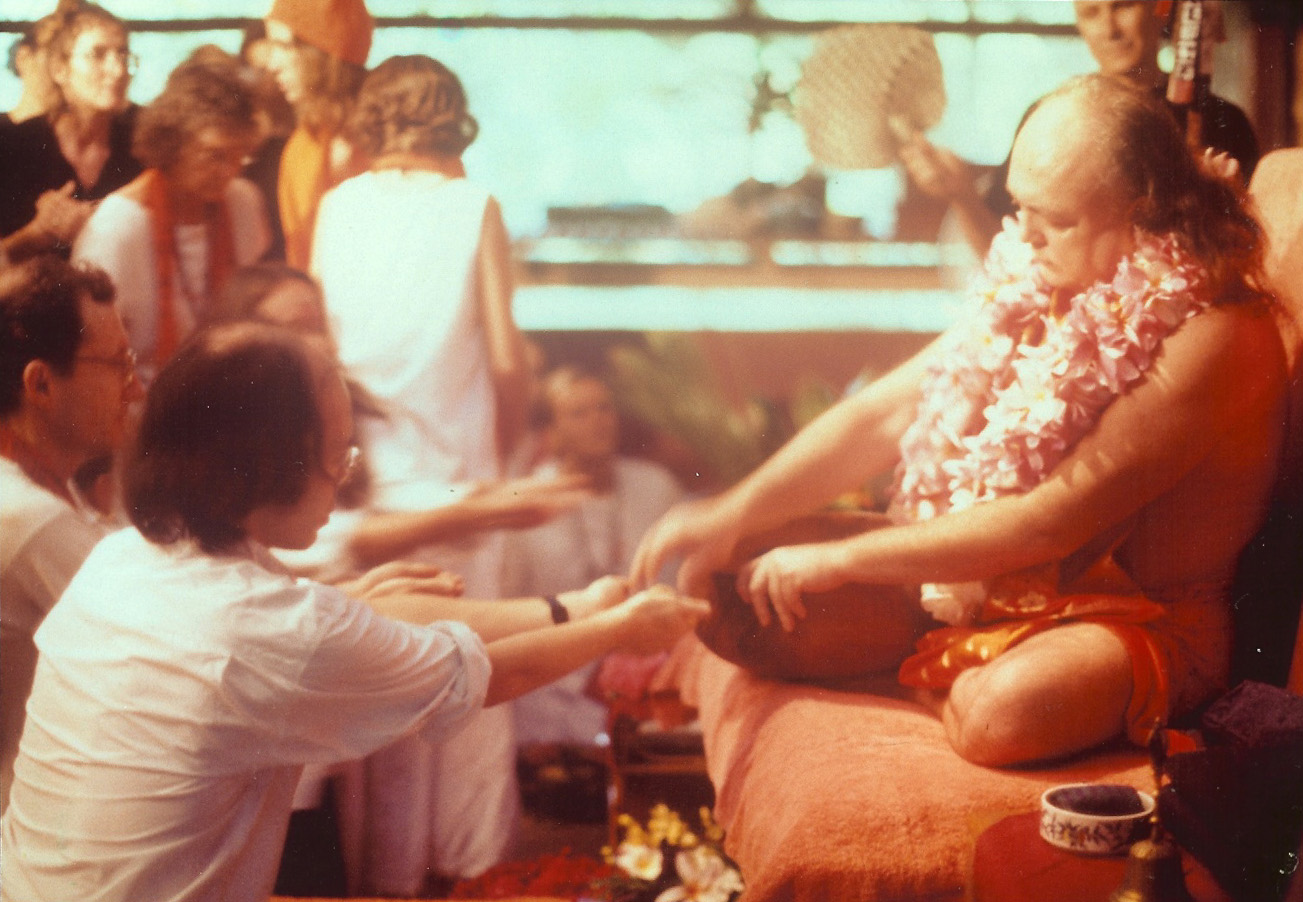
Adi Da giving Chris Tong prasad after the performance (click to enlarge) |
After the performance, the first responses — from our devotee friends in the audience — were encouraging: they had been moved by the performance. And they liked the music! Then word came that Adi Da Himself was very pleased with the performance (confirming that He too felt that the performance had served the purposes He had intended). So much so, that He invited those of us responsible for the performance to a gathering with Him in His bedroom a couple of nights later.
I was ecstatic.
But then a perverse thought came up: What if He liked the performance in general a lot, but didn't particularly like the music?
Looking back these many years later, it seems like a completely ridiculous thought, and a not particularly important one at that (in that the performance had succeeded in its purpose). I now understand that "do whatever pleases your Guru" is to be accompanied by a "karma yoga" disposition: "Do whatever pleases your Guru" guides all one's actions; the occasions of your Guru letting you know your actions pleased Him are truly wonderful ones; but you are not attached to that outcome. The whole point is forgetting "self", and remembering the Guru instead!
But I didn't fully understand that at the time. (As with many aspects of practice, one's understanding of such principles and admonitions is refined with time and experience.) And so I let that question, "Did He like my music? Did I please my Guru?" plague me now and again, until the night of our gathering with Adi Da finally arrived, and we packed ourselves into the truck and drove out to be with Him, in His Bedroom at Aham Da Asmi Sthan.

Adi Da's Bedroom at Aham Da Asmi Sthan (click to enlarge) |
Of course, once I was with Adi Da, I quickly forgot my "concern", both because of our being in the extraordinary "Brightness" of His Company for such an extended and intimate period of time — He Sat on His bed and we all sat around the bed for the next seven hours or so; and because that night, He engaged us so fully in so many vibrant, living considerations that one couldn't possibly hold on to such a small concern.
During the course of the evening, He engaged one devotee in a consideration that led the devotee to make a choice of celibate renunciation, for the sake of that devotee's further growth in practice. He led another devotee through a consideration about his recently deceased intimate and their relationship. He had many more such considerations throughout the night with many of the devotees in His bedroom. And while He was taking His devotees through these extraordinarily personal and substantive considerations (each aimed at growth in their practice), all the while, He was also generating new Teaching that would prove useful for all His devotees around the world.
Here is just a taste from His hours of consideration with us:
If you look at it, life is more about dying than about being alive. You people are thinking you just live to get laid. How much actual time have you spent getting laid? [All of us talk at once.] That's what you lived for for the years you've lived so far. Count up the number of actual minutes or hours you actually spent getting laid. You lived for it, and how much time did you actually spend doing it? A few days, a week or two, all told? And even that you thought you were doing as a matter of free will, but it was just some reproductive insanity, some [biological] program forcing you to do it. Of course, you volunteered because you don't know the difference between the body and God, and wasted your life with all that enthusiasm, lost all your discrimination, and got obsessed with other things like food and TV. What the fuck is the point? It's all horseshit. [He laughs]...
You bullshit yourself all the way through, you see, and what it comes down to is the only time you get serious is when you die. Then you find yourself almost totally unequipped and you see the little headlight right there and then zoom! Right past you. You missed it again. Shucks! [Laughs.] That's what happens. And you've all done it many times before and that's why you're here right now. You missed it every time. Basically, you're still bargaining. Your case is getting sort of academic.
You are not going to get any relief by merely dying. . . . Going down the tunnel and seeing the Light is just the first step. People talk about it as if it is the ultimate result. It is just the beginning! If you don't Realize it as the Divine or Very Condition it keeps on getting modified. It is only "Jesus" (or whomever you may see) for a brief time. Then it becomes your limitation, your fear, your self-possession, visions, appearances, associations, dreamlike blah blah blah, until there is, in all this spinning, a reconjunction with another exposition, which is reincarnation, perhaps, either in this human condition, or in some other condition, non-human or other than human, here or in some other arbitrary plane perhaps, depending on the development of the individual. . .
You cannot die right without dealing with Reality. You cannot die right without living right or in Reality. You can actually avoid Reality altogether, in life and death, if you identify with this contraction, this separativeness, self-possession. But this is not merely a matter of importance at the end of life. It is a matter of importance in life. But you have to be rather serious to get real. Most people aren't very serious, in general. They don't particularly get real. They just play all these absurd games that human beings play — this kind of satire or mummery. And that's part of what My book, The Mummery, is about. Life without this greatness is a mummery, a mock show, a way of avoiding Reality. . . .
You could see why I forgot my little concern in the midst of such profound wisdom about truly significant matters! Even so, that now forgotten question ("Did My Beloved Guru like my music"?) lay dormant in my psyche and had not yet been released or dissolved.
Dawn finally came, and Adi Da ended the gathering so that we all could get some sleep. We stood up and slowly filed out of our Guru's bedroom, each of us thanking Him and saying good night to Him just before we left His room.
Just as it was my turn to leave, Adi Da looked straight into my eyes, and said softly. . .
"I liked your music, Chris."
My forgotten, buried question exploded to the surface and disintegrated! My heart broke open like a cracked egg, and a flood of love for my Guru poured out. I grabbed His hand and kissed it: "Thank you, Lord!!" And left His bedroom, overwhelmed by the Happiness of pleasing the Guru and being released from "self" and its concerns.
* * *
Adi Da had revealed to me, on this occasion and several others, how He could completely read whatever was in my mind and heart, because He was me.[4] But extraordinary as that was, what was just as extraordinary to me was how He never used this Siddhi arbitrarily. He would always choose (with masterful, even surgical precision) exactly the right moment and the right way of Revealing what was in one's own heart to break one's heart open and release it from self-contraction, restoring it to its Native State of Happiness and to fullest love of its Divine Guru.
Another aspect of what He was doing was helping me handle "unfinished business" (which we discussed at length in an earlier chapter). Even though it had slipped below the level of consciousness for me, that question and concern — Did Adi Da like my music? — was sitting there in my psyche as "unfinished business". . . completely evident to my Divine Heart-Master. Since that business involved Him, it was very natural for Him to do what was necessary to bring me psychic closure, so the matter could be released and I could move on psychically:
You must handle all business. I have known this all my life. I have always worked to handle business with everyone. In fact I have always worked to help other people handle business with one another. I have always handled business with my mother and father, but also worked to help them handle business with one another, however much they could. I have handled business. I insist upon handling business, and always have. You should do likewise. You must handle business. The residual effects must stop affecting you. You must notice what is affecting you. In one fashion or another, through the instrumentality of Truth itself, you must handle business. Even at a later date. You must. You cannot continue to grow, you cannot move on until you handle this business.
In these most direct ways, Adi Da repeatedly showed me how He was truly the Heart-Master of His devotees.
FOOTNOTES
| [1] | In 1995, The Mummery Book was essentially still identical to the first version that Adi Da wrote before His Re-Awakening in 1970, and its annual performance was about four hours in length. Over the following decade (starting on May 27, 1998), Adi Da would expand it to something more like three times that length. | |
| [2] | "having 100% of their energy and attention available for the task at hand, whatever it might be" — as opposed to much of one's energy and attention being wasted by resistance to doing the task, self-doubt, upset at not getting it instantly right, reactions to others one has to work with, etc... all the things that egos usually do. | |
| [3] | An orchestral treatment of music composed for The Mummery Book is well within the realm of possibility. One of my fellow devotee composers, John Mackay, who himself has composed music for The Mummery Book several times, has honed his craft of musical composition to the point where he could certainly put together orchestral arrangements with the sophistication I am imagining — just listen to an orchestral performance of his piece, Soli Gloria, to hear what I mean. (John composed and orchestrated the piece, and is the pianist in this performance.) | |
| [4] | Many devotees have attested to Adi Da's ability to completely read whatever was in their minds and hearts. Here is another extraordinary story about that. | |
| [5] | For a longer version of this story that contains many of those lessons, click here. |