Finding
Adi Da > Chris Tong > Part IV (Waking Up) > Overview
Finding
Adi Da > Chris Tong > Part IV (Waking Up) > Overview
IV. Waking Up From the Dream:
A Hard School But A Happy Way Of Life
Overview

Much of PART IV is still in development. Many sections have yet to be written, while many other sections are drafts, with notes to myself. Despite the incompleteness, I am making PART IV available even in this form because it already contains material that can be of significant help to current practitioners of the Way of Adidam.
PARTS I and II of this book were full of stories of wondrous events and interactions and ecstatic states of being that were made possible by being in Avatar Adi Da Samraj's Divine Company both during His human lifetime and after.
Such stories are truly amazing! And most of these were a direct consequence of my practice of the Way of Adidam. For this reason, what is amazing and moving in a different way are stories of fruitful practice, where you read of useful concepts, lessons learned, and capabilities developed along the way that contributed to fruitful practice of the Way of Adidam. These stories are meant to be inspirational, to move you to want to engage this practice yourself!
So the reason you like hearing stories about Saints and ecstatics is that they are people who do not do what people usually do. You would like to be someone who is doing what people do not ordinarily do. You would like to be in that ecstatic position. Fine! So do it! You have been given the Means. You have had your "consideration". Be an ecstatic, then. That is My Recommendation.
What I Bring to here Is the Divine Avataric Self-Revelation of Reality Itself.
What I Bring to here Is the Absolute Divine Itself, Self-Revealed.
What I Bring to here is not mythology.
What I Bring to here is not “religion”.
What I Bring to here is not anything that human beings already “know”.
What I Bring to here is not a path or a search that is already evident in the history of the Great Tradition of humankind.
What I Bring to here has never been offered before, never heard of before, never practiced before.
The Way of Adidam offers the greatest possible Realization and destiny: Divine Realization, the complete Awakening from the dream of conditional existence to the Unconditional, Eternal State of Divine Happiness. For this reason, practice of the Way of Adidam is the most challenging enterprise a human being can engage in. That is why we have created PART IV — to give you a sense for what practice is like: its details, its difficulties, and its joys. PART IV is also an invitation for you, the reader, to take up this practice! Challenging as it is, it bears fruit from the very beginning: even the beginner's practice is Communion with the Divine, Communion with the Divine State of Eternal, Unlimited Happiness. Adi Da has said of the Way of Adidam: "It is a hard school, but a Happy Way of life."
Because the Way of Adidam is as Adi Da describes it above — "never offered before, never heard of before, never practiced before" — the first few generations of practitioners of Adidam are truly pioneering something radically new. And for this reason, PART IV of this book will focus on and viscerally illustrate (through stories and personal examples) key concepts in Adi Da's Teaching and insights from my practice and that of other devotees that may be especially useful for better understanding the practice of the Way of Adidam by newcomers, and more fruitful practice of the Way of Adidam by beginning practitioners. No doubt these "pioneer concepts, insights, and lessons" will be greatly refined by thousands of other practitioners in the coming centuries. But the ones presented here are intended as a "starter kit".
Adi Da never intended the culture of Adidam to be only devotees reading His Words and practicing on that basis, each on their own. For decades, He worked with small groups of devotees in order to create an additional, more actively engaged resource: a group of advanced practitioners that could "pass the Prasad" to other devotees, helping them grow in their practice through personalized guidance, based on insights gained from their own growth in practice beyond the level of the devotee they were helping. Adi Da referred to such devotees as His "coins". Because the entirety of each person's body-mind is given over to programs aimed at survival and materialistic fulfillment, every aspect of the body-mind has to be re-programmed in order to see the practice start bearing fruit. It is very easy for even the most able and willing devotees to miss or fail to realize the importance of some "small" detail, and not realize that that "little detail" is what has been keeping them from growing (for days, months, or years). The help of someone else who is more advanced in the practice observing them, spotting that detail, and helping them correct it can be invaluable.
Here's a very simple example. One devotee was struggling with the conductivity practice in the Way of Adidam — the practice of conducting energy down the frontal line of the body and then up the spinal line, in a circle. She had mastered the "frontal line" part of the practice. But no matter what she did, she couldn't get the energy to "turn around" at the perinium of the body and ascend up the spine. Fortunately, she was able to ask Adi Da for His help. He stood before her and observed her as she did her conductivity practice. He suddenly exclaimed, "You're not sitting up perfectly straight!" He then helped re-position her body. "Try it now!" And for the first time, she was able to feel the energy turn the circle and flow up her spine.[1]
She had read Adi Da's written Teaching on the conductivity practice many times. But she never would have figured out that the problem was this specific detail in her posture, without Adi Da's direct observation and help.
The Divine Conscious Light is Above your heads! Just sit up a little straighter!
Adi Da's human life ended before He was able to grow devotees in practice to the degree where they could serve as His "coins", in this very practical manner of being able to provide personalized guidance to other devotees on their practice. So instead we all have been given what Adi Da has called "the Grace of time". With the passage of time, some devotees are growing in certain aspects of the practice. Their growth process, insights gained, and lessons learned, can be shared with others and serve as an "empirical supplement" to Adi Da's Teaching — a very practical form of "Leela-telling": all devotee growth in the Way of Adidam is a central part of Adi Da's Divine Leela — it is the proof that the Way of Adidam works!
And it is our responsibilty as Adi Da's devotees to accomplish this. Adi Da once said He was like Albert Einstein, who wrote the original, breakthrough research papers introducing revolutionary, new ideas like relativity. But Einstein didn't write textbooks that could make his ideas broadly accessible. That was the work of others. Just so, Adi Da wrote the Source Texts, laying out the Offering of Adidam, and it is our job as devotees (not His job) to find a way to make His Teaching accessible to increasingly broader groups of people — both devotees (the purpose of PART IV) and non-devotees (as described in an earlier chapter, How to "Tell Everyone I'm Here": Re-Educating the Eight Billion").
So PART IV of this book is my contribution to that "empirical supplement" to Adi Da's Teaching, written in an accessible manner. It draws, first and foremost, on my own experience of practicing the Way of Adidam. It also draws from the culture of devotees — from the the conversations I have had with hundreds of devotees about their practice over the years, having served in many cultural service positions, including head of cultural education at Adi Da Samrajashram; head of Worldwide Adidam Education; head of the Lay Renunciate Order; Adi Da's cultural sarvadhikari; and manager of several devotional groups.
PART IV is full of practical guidance for fulfilling the Way of Adidam, like the conductivity example of "sitting up straighter" that we gave earlier. Because of my professional background as a university professor and educator, I have a tremendous focus in this PART on making sure readers actually understand what I’m trying to communicate, to the point where they can try it themselves if they are practitioners of the Way of Adidam. So there will be a focus on providing practical details. Here are just a few examples, to give you a taste of what is coming.
- We’ll focus on the process of growth, wherever possible. It's very hard to grow in a particular area if you don't have a clear picture of what the process of growth in that area looks like. In my observation of devotees over many decades, I would say that is the single biggest missing educational element: a detailed model of the process of growth in many key areas of the practice. For this reason, Chapter 3 aims at providing a detailed model of the process of "filling the cup". Chapter 4 aims at providing a detailed model of the process of growth in self-understanding. Etc. The only thing I can't say much about at this point is how broadly applicable the process models described here will prove to be, since they are based on a relatively small “data set” of devotees.
- We'll talk about essential elements that are missing from (or weak in) most devotees' practice. Here's an example. Every devotee knows that the practice is supposed to be moment-to-moment. But if your practice really starts getting close to being moment-to-moment, it is likely that you soon will become aware of a huge lapse in your "moment-to-moment" practice! Here's how I discovered it. The practice is Divine Communion. So if you are doing that practice moment-to-moment throughout the day, you are in a state of Happiness much of the day! When I reached that point, I noticed something that stood out in a big way: on some mornings, I'd wake up feeling very contracted, compared to the Happy state I am in most of the day. The reason was clear — there was a huge hole in my "moment-to-moment" practice: those six to eight hours each night when I was asleep and I was not practicing! And the contracted state I felt when I woke up on those mornings was the cumulative effect of not practicing for hours. (When you're not actually practicing Divine Communion moment-to-moment, you don't really notice this, because the contraction during much of the day is not very different from the contraction when you wake up from sleep.) So we'll talk about how to practice while sleeping, so
"moment-to-moment" practice can truly become 24/7.
- We'll talk about ways to streamline the practice. For example, in the fullness of the beginning practice of radical devotion (Samraj Asana),[3] one "feel-surrenders to Adi Da" with the head area, and the heart area, and the vital area below the solar plexus. But when one gets good at this, and is largely doing this moment-to-moment, then often, a "low maintenance" way of staying in that surrendered disposition can be done simply as a single, unified gesture of feeling surrender with the whole body, rather than three distinct gestures, of head, heart, and vital. This is similar to other bodily skills one learns. For example, when one learns how to drive a car, one begins by learning what to do with the right foot (on the accelerator), the left foot (on the brake), the hands (on the wheels and the gear shift), and the eyes (looking at the front view, in the mirrors, etc.). Understanding what each body part needs to do is a natural starting place. But that's only the starting place! Over time, one is no longer experiencing driving as something you do with the individual parts of your body: your left foot, your right foot, etc. Instead, we experience it with the whole body: the whole body engaging the car and the road from moment to moment in a kind of dance or flow. And it is also only when we get to that point that we can handle more complex driving challenges, like managing the car in a skid.
- Perhaps most importantly, I'll be providing as much detail as I possibly can for every aspect of the practice I describe. It is my strong sense (from talking to hundreds of devotees, as well as from my own experience) that lack of detail is profoundly contributing to the lack of advance in practice, and so I am aiming to help with that here.
A reading sample from PART IV. Just to give you sense for what I mean by a providing a lot of detail, here is a section about "Conducting the Spirit-Blessing In the Circle" from the chapter, Filling The Cup:
The general practice I have Given you is not about observing breaths, counting breaths, noticing breaths in any technical fashion.
It is about entering into relationship with Me via the breath, Communing with Me via the breath.
The breath is not the subject of your practice. I Am! All the faculties of the body-mind must be devoted to Me, and, since breath is a primary faculty, you must exercise yourself in relation to Me via the breath.
The practice is not to get very curious about the breaths themselves, or finicky about breathing. It is to devote yourself to Me completely and to use the leading faculties of the body-mind as a principal mechanism for it. It is a devotional practice, then, not merely a functional one.
The Spirit-Blessing is received frontally, through breathing It in. It is not a matter of letting yourself disappear or becoming negated, but of receiving my Blessing to you, breathing It in, opening up your feeling, feeling It in your face, your eyes, all the parts of your face, your head, your brain.
Breathe It into your throat, all of your chest, down to your heart, and your solar plexus and your abdomen. Breathe It into your vital organ. That is how you know you have received my Blessing. That is how you receive the Holy Spirit — frontally, through inbreathing.
Having received It, then you exhale, release It, relax yourself altogether, and shoot It up the spine into the brain and beyond.
That then is your gift. That is what you bring to the Spiritual Master. What you receive from the Spiritual Master you receive frontally. You in-breathe It, you inhale It. Then you exhale as a sacrifice, having received It.
You cannot exhale and release It until you have received It. You receive It in your face, your heart, your abdomen, your vital life, in this bag of guts here! You feel It tangible, know that It is there, regardless of any activity on your part.
* * *
Fundamentally, “radical” devotion to Me is a moment to moment practice. In terms of the breath, it is to practice reception and release directly in relation to Me — receiving Me, releasing yourself, releasing all content.
It is a random noticing and engaging of the breath. If the practice is done rightly, artfully, at random, then (effectively) every breath becomes devotional Communion with Me, the process of receiving Me, releasing yourself into devotional Communion with Me.
The conductivity practice in Adidam begins by circulating the natural energy of the body-mind down the frontal line and then up the spinal line. As practice in Adidam develops, in addition to that natural energy, the Hridaya-Shaktipat — the Divine Spirit-Blessing — is circulated down the frontal line and up the spinal line.
The Adidam practice of conductivity involves two circuits that overlap (see diagram below): the circuit of natural energy around the circle in the body-mind (red); and the much larger circuit of Divine Spirit-Blessing, that starts with the Divine infinitely above the head, descends down to the head, then down the frontal line, then up the spinal line, then returns to the Divine, infinitely above the head (purple). The two circuits overlap in the body-mind, where we are conducting both the natural energy of the body and the Divine Spirit-Blessing.
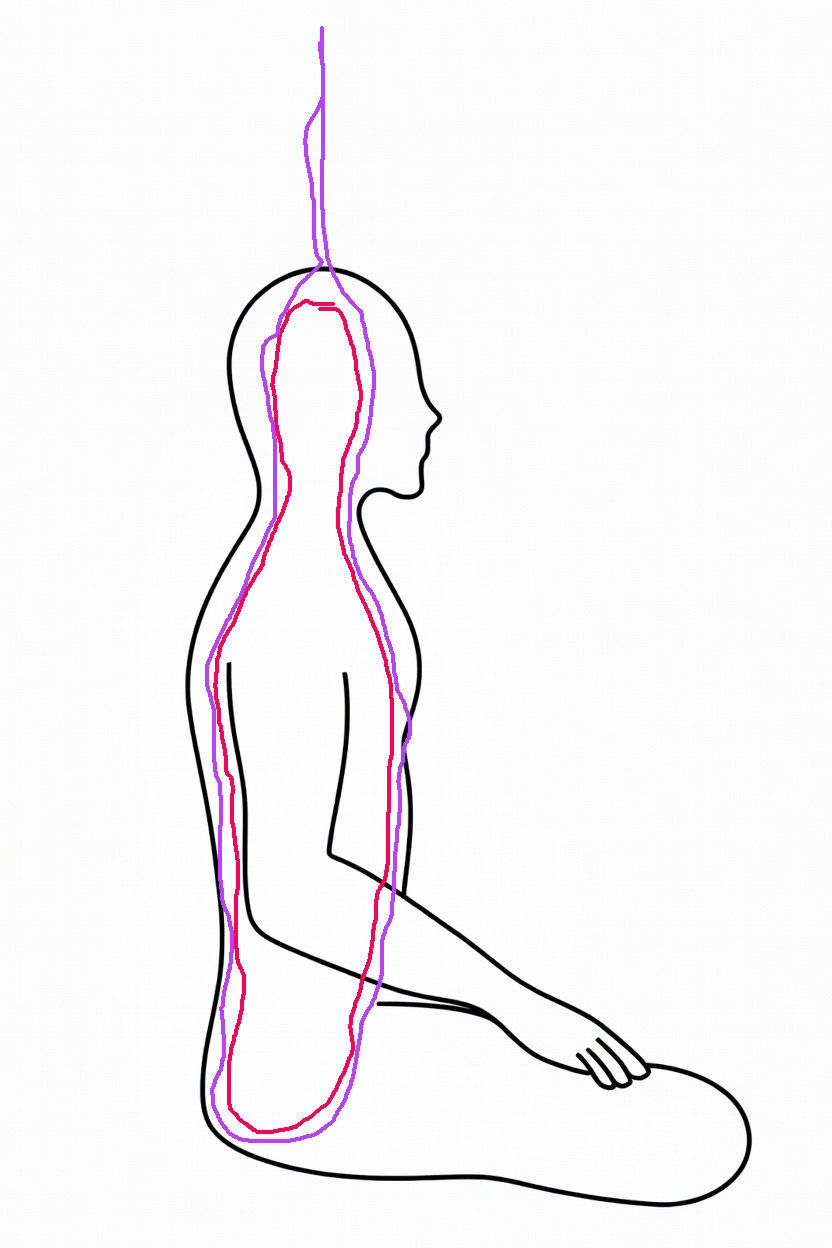
Click image to enlarge
Conductivity of the Spirit-Blessing is as much a matter of feeling as it is breathing. You definitely must breathe deeply — deeply enough for the breathing to reach and touch the perinium. But you also must be fully feeling, from the head all the way down to the perinium, and you must be locating Adi Da and His Spirit-Blessing with that feeling capability, by allowing the feeling to be a response to Him. Another way of describing it: you are invoking the Divine, and allowing the Divine to Emerge, all along your frontal line, in synch with the breath.
When you have gained facility at conductivity, then the turn of the Spirit-Blessing around the circle at the perineum will match Adi Da's description: you "shoot It up the spine into the brain and beyond". But before I developed that facility, it was very useful to just focus on getting the Spirit-Blessing around the perineum and feeling that Happiness strongly, first in the perineum itself, and then in the lowest part of the spine just above the base. (So at the end of the inhalation, I am breathing deeply and am feeling the Spirit-Blessing hit the perinium.) When this becomes comfortable, natural, and easy, then you focus on bringing It up a little higher. And then a little higher. And so on — until finally, you can "shoot It" all the way up the spine, so that the entire spine is full of the Spirit-Blessing.
Apart from what is required for breathing, you are not using any muscles (e.g. back muscles). You may find it useful to do a light kegel both to "contain" the Spirit-Blessing (keeping It from leaking out the base) and to "direct" It upward. But only a very light kegel — otherwise you can end up obstructing the Current.
The "movement" in the circle — both down the front and up the back — may not even feel like a "flow". It may feel more like you are feeling more and more areas of Happiness "turn on", "light up", or "Emerge", further and further down the frontal line, and then further and further up the spinal line, until the whole circle is lit up. It's not the Divine turning a finite "piece" of Itself into a liquid stream and sending It flowing through the circle!
One thing you should understand relative to breathing-“conductivity”: It is not really a matter of breathing Me in. It is a matter of breathing in Me.
I am All-Pervading. Therefore, inside the body or outside the body, what you are doing with the breathing, founded in the heart-disposition, is allowing the body to move into a state of equanimity in Me.
If you have been a lifelong shallow breather, you very likely have been using only the upper chest muscles for breathing. But deep breathing requires using the diaphragm in the abdomen as well. And when you raise the Spirit Blessing in the spinal line, you also must be using the diaphragm. You can’t do it with the chest muscles alone! But if you’ve been a lifelong shallow breather, you inadvertently may be trying to do just that. If that is the case, you need to consciously develop a new habit. You'll know you're using the diaphragm because you'll feel the abdomen moving in and out.
If, like me, your vital area has been largely collapsed and contracted for much of your life, then when you focus on the spinal ascent of the Spirit-Blessing, there may be a tendency for the frontal line to collapse in the vital area, relapsing to your former habitual, contracted state. It can even feel like you are needing to empty out the vital of the Spirit-Blessing in order to shoot It up the spine. But in fact, there's nothing preventing the vital (and, indeed, the full frontal line) from remaining uncontracted and full of the Spirit-Blessing even as more of the Spirit-Blessing is appearing in the spine — until the entire circle is full of the Spirit-Blessing. (We'll talk about transcending the "vital shock" — the self-contraction in the abdominal area — in the next chapter.)
The more Spirit-Blessing there is in the circle, the easier it is to circulate it around the circle. So it's easier to fill the spine with the Spirit-Blessing if the frontal line is full of the Spirit-Blessing (rather than "spotty" — a little here, a little there).
It is also natural during times of relaxation for the breathing to be deep and slow, and for there to be a few seconds of kumbak (pause) after the inhalation (but before the exhalation), and after the exhalation (but before the inhalation). This is not anything you try to make happen — it happens spontaneously. However, if you notice that it is not happening, the reason is typically that the breathing is contracted to some degree, and so you need to locate and release the contraction, to allow kumbak to spontaneously occur.
The conductivity practice in Adidam is very different from the practices of the Kundalini traditions. The Kundalini practice shoots the natural energy of the body-mind up the spinal line to the crown chakra (without any awareness that there is also a frontal line and a circle, and that the energy in the base of the spine is coming from the frontal line, not from some mysterious source of energy at the base). The conductivity practice in Adidam begins by circulating the natural energy of the body-mind down the frontal line and then up the spinal line. As practice in Adidam develops, in addition to that natural energy, the Hridaya-Shaktipat — the Divine Spirit-Blessing — is circulated down the frontal line and up the spinal line. The primary purpose of that "Crashing Down" of the Divine in the circle of the body-mind is to purify the whole body-mind, preparing the being to transcend the body-mind and enter into the Perfect Practice, which takes place in Consciousness Itself, not the body-mind. In contrast, the purpose of the Kundalini traditions is to shoot the natural energy of the body-mind up the spine to the crown chakra and activate various spiritual/visionary experiences as a result. There is no Divine Spirit-Blessing involved in the Kundalini traditions.
. . .each cycle of breathing is full and profound, so that bodily and relational feeling is heightened and expanded with each inhalation and exhalation.
The pattern of breathing that we observe in these periods of ease is the true and natural breath cycle, the unobstructed mechanism whereby we contact the Radiant Current of Divine Life and conduct its Energy throughout the body and even allow it to pervade the World. Under the more ordinary or active circumstances of life we do not tend to breathe in this way. Observe yourself. Feel the shallow inhalation and almost nonexistent exhalation of your usual breathing. Feel the contractions in the body as the breath encounters tangible obstructions. Feel the urgency in the breathing, as if breath and existence itself were threatened. Such breathing is inherently dis-eased; it barely sustains even the gross physical functions of oxygenation and elimination of toxic wastes via the lungs.The natural cycle of the breath, in contrast, is a primary element of the practice of religious and spiritual life, and it is the secret of health and longevity, for it is through right breathing (as well as Awakened Feeling-Intuition) that we feed upon the Divine Current of Radiance that animates, sustains, and regenerates us whole bodily, and ultimately dissolves us into Itself.
The retained breath, or kumbak, as it is called in the yogic traditions, is essential to the natural cycle of breathing. Via the inhalation, the Life-Force circulates throughout the body, purifying it of emotional and mental as well as physical obstructions, harmonizing its functions, and enlivening every cell with Bio-Energy. When the inhalation is retained, the Life-Force has more time to do its purifying, balancing, and rejuvenating work. Likewise, when the exhalation is retained, the toxic obstructions (physical, emotional, and mental) dissolved by the inhalation and kumbak are fully expelled, and the Life-Force itself is allowed to radiate through all the bodily functions to Infinity.
Full, steady, and conscious breathing, with kumbak, is a primary practice of conscious exercise. We should enter into Love-Communion with the Living God under all conditions, via all our actions, and, in that natural alignment to Life, the feeling breath attains its proper order—full, at ease, with natural pauses at the end of every inhalation and every exhalation. (It was by this pattern of breathing and feeling, combined with other right moral, personal, psychic, and spiritual disciplines, that the ancients realized Divine happiness and extraordinary longevity.)
Even though they are not the purpose of the Divine Spirit-Blessing, Adi Da has said that kriyas, visions, and blisses can occur as as a secondary effect of the Hridaya Shaktipat. I'll mention just one such secondary effect in my own experience.
While I was focusing on learning how to conduct the Spirit-Blessing up the spinal line, I had an unusual dream. In the dream, my back was pressed against the body of a woman. She told me her name was Philomela.[2] We were pressing against each other, my back to her body, and the feeling was one of intense Bliss in my spinal line (and the Bliss "included" both of us, so she was feeling it too). It was like a sexual experience, but it was happening entirely in the spinal line, not the genitals. I awoke from the dream, and continued to feel that intense Bliss in the spine.
So the above reading sample should give you a feeling for the level of detail I'll be providing.
The core of our practice of the Way of Adidam is a relationship — the relationship with Avatar Adi Da Samraj — not a technique. But that relationship is supported by all manner of secondary and supportive practices, that have all kinds of technical details. The Way itself is not a technique; but you must master all kinds of techniques to fully serve and support that relationship! That's true in any relationship. The core may be the relationship — the love of the person. But you might have to learn all manner of techniques to serve that relationship, from cooking, to changing diapers, to CPR — all done as an expression of your love for that person, and your understanding of what that love requires in practical terms. And, as I mentioned earlier, in the relationship with Adi Da, "little" missed details in any of the secondary and supportive practices of Adidam can keep even the most willing practitioner with the strongest heart-response to Adi Da from growing significantly in the practice for days, months, or years. I say that from personal experience! So much of what is in this PART also is aimed at saving the practitioner reader from wasting much time by my passing on lessons and technical details I and others have learned (often much more slowly and painfully than if I had had someone to tell me the right way to do some aspect of the practice).
I mentioned earlier how Adi Da said He was responsible for writing the Source Texts, and we were responsible for writing books that could serve as textbooks and other teaching tools. That means writing books that are designed to be accessible for specific “grade levels” of people — from spiritual seekers in general, to beginning practitioners of the Way of Adidam. PART IV is organized as an introductory manual for beginning practitioners. But it is also written in a way that is intelligible to non-devotees, even if what you're reading about is not yet something in your own experience. (One way I go about doing this is by minimizing my use of technical Adidam terminology, wherever possible.)
PART IV is organized as follows:
- Introduction: Waking From the Dream
- The Fundamental Asanas in the Way of Adidam
- Fruitful Practice Depends Upon Correct Asana
- The Asana of Turning to Adi Da and Being Happy
- The Asana of Turning to Adi Da and Living Whole Bodily in the Divine Domain
- Being Completely Happy: Magnifying Happiness in Space (Whole Bodily), Time (Moment-To-Moment), and Intensity
- The Great Secret of Inter-Dimensional Identity Shift
- Recognition: Tacit Awareness of the Divine Domain
- Searchless Beholding: the Samadhi of Absorption in the Divine Domain
- Benefits of Living in the Divine Domain
- Greater Intensity of Happiness
- Benefits of Living in the Divine Domain
- Greater Awareness of the Divine as A Non-Separate Dimension: Ordinary "Translation"
- "MORE!" — Transcending Doubt and Starting to Grow Again
- The Beginner's Plateau in Practice
- Beyond the Presumption of Unfruitful Practice
- Two Stories of MORE!
- The Two Doubts
- Doing What We've Never Done Before
- The Devotional Prayer of Changes For Growth in Practice
- Not Going Back to Square One: Moment-To-Moment Practice and Not Breaking the Circle
- MORE! of the Divine Emergence in Time and Space: Moment-To-Moment, Whole Bodily Practice
- His Qualifications: The Horse Takes You
- Conclusion: Nothing Inherent in You Is Holding You Back From Infinity
- Transcending the self-Contraction: From Graceful Release to self-Understanding
- A Childhood Story of Vital Shock
- Non-Egoic From the Start: the Way of Adidam as a Seventh Stage, Counter-Egoic Practice
- Tools for Deepening self-Understanding
- Graceful Release of the self-Contraction
- A Depth Model of Egoity
- self-Understanding: Developing Personal Responsibility For the self-Contraction
- Listening: Understanding the self-Contraction As Our Own Activity
- "Getting Down": Becoming Responsible for the Contraction of the Vital
- The Conventional Understanding of "the Knot in the Stomach" and What To Do About It
- Understanding the Natural and Neurotic Phasing of the self-Contraction
- Reducing the Triggering, Re-Knotting, and Strength of the self-Contraction
- Positive Disillusionment Revisited
- Hearing: Fundamental self-Understanding That Releases the Whole Bodily Sense of Separate self
- The Evolution of the Listening-Hearing Process in the Way of Adidam
- Listening-Hearing-Seeking in The Knee Of Listening: Adi Da's Ordeal Prior To Having Adi Da's Teaching
- The Devotional Way of Insight and the Devotional Way of Faith
- How the Ruchiradam Event Changed the Listening-Hearing Process
- How the Core Practice of Radical Devotion (The Way Of Me) Supercedes the Earlier Practice of Radical Understanding
- Setting Aside the Conceptual Mind
- Integration: Full Maturity in the Third Stage of Life
- Turning Every Moment into God-Communion
- The Bangles of the Goddess: The Trap of the Lesser Samadhis
- "What Is Your Conclusion About Reality?"
Another goal I had in mind with PART IV is that, if you read this PART, it should make reading Adi Da's far more elaborate and comprehensive descriptions of the practice of Adidam (in books like The Aletheon, The Dawn Horse Testament, etc.) much easier than if you started with them — something like the way you study elementary school and high school math before you tackle calculus in college.
* * *
Adi Da's Teaching provides a complete, general template for practice of the Way of Adidam. Adi Da's observations of and interactions with devotees led Him to add all kinds of detail to that initial template, often distinguishing special cases of His general template. For example, a lot of the parenthetical remarks He added to The Dawn Horse Testament — much of which is a kind of manual for the practice — were added based on what He observed in His devotees — in particular groups of devotees, or even in a single devotee. He had said that His devotees (including all their egoic patterns and resistance to practice) were means He used to manifest the Teaching:
You all, meaning the whole community, should be championing this Teaching, communicating this Way, stabilizing this institution, creating communities, keeping the literature available everywhere, in all kinds of languages, devoting yourselves to benign communication of the Way and practicing it in your place. That is what we should be doing in the future, not struggling anymore with the beginners reluctance. That struggle has served its purpose, which was to motivate me to Teach, to cover all the bases, to deal with everything. Now you have done it. That was really good! That was really great! That was a great job you did! (Laughter) You are collectively an Avatar of reluctance! (Laughter) Very admirable — may you be praised for generations! (More laughter) But you have now served your purpose, and now you must become a different kind of Avatar. It is time we made a change.
And because, during His human lifetime, most devotees did not grow beyond the beginning stage of practice, the chapters associated with beginning practice tend to contain much more detail than those associated with more advanced practice (or transitioning from beginners' practice to advanced practice), which consequently have more the form of a general template. So in the coming years, decades, and centuries, it will be the responsibility of devotees to flesh out and document details they discover as they grow in practice. PART IV of this book is one devotee's report, to help initiate that process of documentating details and telling the stories in Adi Da's Divine Leela that are about how to do the practice fruitfully.
* * *
In addition to having a will to practice and a will to grow in practice, it is essential that some devotees in this transition period — after Adi Da's human lifetime but before there are large numbers of advanced practitioners in the Way of Adidam — have a will to getting every detail of the practice correct, so they can pass this on to other devotees. Let's return to the example I gave of the woman devotee who didn't realize — until Adi Da observed her and pointed it out — that her conductivity practice wasn't working because she wasn't sitting up straight, and was sitting on (and blocking) the channel through which energy needed to flow freely. It was good that Adi Da was there to guide her. But it's also true that our conductivity practice is something that we practice all the time, not just sitting in the meditation hall. Had she actually been doing the conductivity practice during the rest of the day — while standing, walking, lying horizontal in bed, etc. — she would have discovered that she had no problem conducting around the circle except when she was sitting up. And that could easily have led her to realize that what was unique about the "sitting up" position was that that was the one position in which she could be sitting on and blocking the flow of energy in the circle, and that could have led her to correct her own practice. So devotees who, in this manner, are willing to go the extra mile in considering the details of their practice can discover on their own many details that will be of great use in helping their own practice and the practice of other devotees.
* * *
I'll end this overview of PART IV with some inspirational and instructive quotes from Adi Da about the practice of the Way of Adidam.
The trend of attention is a natural force, like wind and earthquake and mobs. An extraordinary discipline is required to turn that tide. Mere "self"-effort is not sufficient. Only the heart-response to My Avatarically Self-Transmitted Divine Grace makes the turn.
Resort to My Grace, rather than to yourself.
Do so fully, with great faith, great response, great heart, great daily discipline, great discrimination, great intent. Do it for real.
Prove it in life. Prove it in My experience. This is what it takes.
FOOTNOTES
| [1] | For those new to the concept of conductivity: this is not to suggest that conductivity requires you to be sitting up straight! The conductivity of the body's natural energy around the circle — down from the top of the head to the perinium, and then up the spine to the head — is going on all the time, regardless of the position of the body. If it ever stopped, we'd be dead! So the point here is that if you happen to be sitting up, you can inadvertently be sitting right on the channel that carries the energy around the turn in the circle at the perinium, and unintentionally be narrowing the flow of energy to the point where you can't feel it. So if you happen to be in a sitting position (as in meditation), be sure you are sitting up straight, in order to not block conductivity. Of course, if you're in any other position than sitting — standing, walking, lying horizontal in bed, etc. — that issue goes away. | ||
| [2] |
| ||
| [3] | See "FOURTH THORN: Details of The Right, True, and Full Practice of 'Samraj Asana', The 'Healing Pose' of Whole bodily (or Total Psycho-Physical) Devotion To Me", in "Part 13: Hridaya Rosary" of The Aletheon for more details. | ||